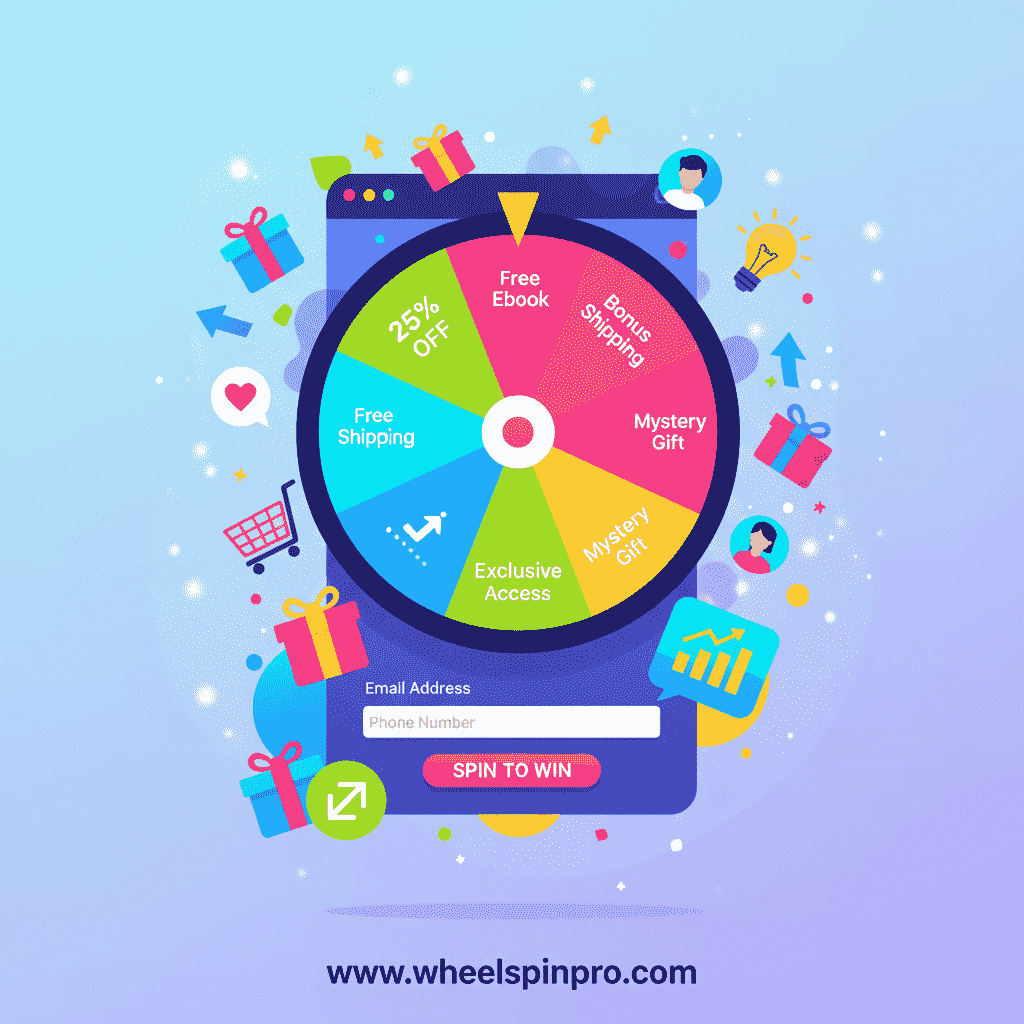
Gamifying Marketing Campaigns with Spin Wheels: The Behavioral Strategy Behind Higher Conversion
Gamification in marketing works. But "works" is a weak claim without understanding why — and most gamification implementations underperform because they borrow the aesthetic of games without the mechanics that make games engaging. Spin wheels done right are not decorations on a campaign. They are a behavioral architecture change.
The term "gamification" has been attached to enough mediocre loyalty point programs and progress bars that it has acquired a faint smell of desperation — as if the brand admitted their core product wasn't interesting enough on its own and needed to be dressed up in game clothing to capture attention.
This dismissal is unfair to effective gamification, which operates through real, documented behavioral mechanisms rather than novelty. And it is particularly unfair to spin wheel gamification, which applies those mechanisms more directly and with more documented conversion impact than almost any other gamification implementation available to marketers.
The reason spin wheels convert better than static campaigns is not that they look like games. It's that they activate four specific psychological systems — anticipation, variable reinforcement, earned reward, and commitment — that static campaigns structurally cannot reach. Understanding those systems is what separates spin wheel campaigns that consistently outperform their alternatives from those that produce a novelty spike and then return to baseline.
This article covers the behavioral foundations of spin wheel gamification, the campaign types where it delivers the strongest results, the strategic decisions that determine campaign performance, and the integration framework for deploying spin wheels across a full marketing funnel.
The Behavioral Science of Marketing Gamification: Why It Works When It Works
Gamification is not a single mechanism — it is a label applied to several distinct behavioral techniques that share the common property of increasing engagement through game-like structures. The techniques that have the strongest, most consistent evidence behind them are:
| Mechanism | What It Does | Marketing Application | Spin Wheel Relevance |
|---|---|---|---|
| Variable ratio reinforcement | Unpredictable reward delivery produces stronger and more persistent engagement than fixed schedules | Any interaction where the reward magnitude varies; the unknown drives continued participation | High — reward tier uncertainty is the core mechanic |
| Dopamine anticipation | Neurological reward signal peaks during uncertain anticipation, not at reward delivery | Any pre-reveal moment; the seconds before result disclosure | Very high — the spin duration is specifically the anticipation phase |
| Earned reward / IKEA Effect | Actively earned outcomes are valued more highly than passively received equivalents | Any format where the user takes an action to access the reward | High — spinning is an active action that confers ownership of the result |
| Commitment consistency | Voluntary action creates forward momentum toward completing the initiated behavior | Lead capture flows where initial engagement predicts downstream conversion | High — entering email and clicking spin is a voluntary commitment sequence |
| Loss aversion framing | Potential loss is more motivating than equivalent potential gain | Limited-time offers; expiring rewards; "don't miss your spin" messaging | Medium — applies in reward expiry and urgency framing, not the core spin mechanic |
| Social proof | Evidence that others are participating increases participation likelihood | Winner announcements, participation counts, social sharing of results | Medium — applies in live draws and public-facing campaigns |
The spin wheel's competitive advantage over other gamification formats is that it activates the top four mechanisms simultaneously — in a single interaction that takes under 10 seconds. Most gamification implementations activate one or two of these mechanisms; spin wheels activate all four in sequence: anticipation builds during the spin, variable reinforcement is experienced at the result, IKEA Effect is triggered by the active spinning, and commitment consistency carries the participant forward to redemption.
Where Spin Wheels Fit in the Marketing Funnel
Spin wheel gamification is not a single-use tactic — it can be deployed at multiple stages of the marketing funnel, with different objectives and designs at each stage. Understanding where each deployment serves the funnel is what allows marketers to extract compounding value from the format rather than treating it as a one-time conversion tool.
The highest-performing marketing programs use spin wheels at multiple funnel stages with coordinated designs — not as isolated tactics but as a coherent gamification layer across the customer journey.
High-Converting Campaign Types: Design Guidance for Each
Email Capture Campaigns
Email capture is the canonical spin wheel use case and the one with the strongest documented conversion data. The core mechanics are covered in detail in our lead generation guide; the strategic considerations for campaign integration are:
- Align reward tiers to the audience's actual value drivers — a discount-tier wheel performs differently for an impulse-purchase audience (where the top tier drives same-session conversion) versus a considered-purchase audience (where the reward must be valuable enough to motivate a future return). Design the wheel for the specific conversion goal, not the generic "what spins usually offer."
- Coordinate with the email sequence that follows — the spin captures the lead; the email sequence converts it. The first email in the post-spin sequence should reference the specific reward won (not generic promotional language), creating narrative continuity between the gamified capture and the nurture that follows.
- A/B test reward structure before scaling — test at minimum: all-win tiered wheel vs. fixed discount coupon (to measure the gamification premium), and different top-tier reward values (to find the threshold where reward value drives conversion without excessive margin cost).
Seasonal Promotions
Seasonal promotions — Black Friday, Cyber Monday, Valentine's Day, end-of-year sales — are the highest-traffic, highest-competition periods in most retail and e-commerce calendars. The challenge is differentiation: every brand is running a promotion, and the consumer's promotional filter is at its most active.
Spin wheel gamification differentiates seasonal campaigns through engagement rather than offer size. While competitors are competing on discount depth, a spin wheel campaign competes on experience — creating a memorable interactive moment that generates brand recall beyond the immediate transaction.
Seasonal spin campaign design principles:
- Deploy earlier than the competition — most brands activate their seasonal campaigns simultaneously; a spin wheel deployed 1–2 weeks before peak season captures early-season traffic with lower ad costs and builds email list depth before the high-competition period begins
- Use time-limited wheel access — "Spin before [date]" adds genuine urgency that "offer expires" language alone doesn't, because the interaction window is limited, not just the reward
- Create season-specific reward tiers — tier names and reward descriptions should reference the season; "Free Holiday Shipping" outperforms "Free Shipping" in December not because the offer changed, but because the framing creates seasonal relevance
Product Launches
Product launches have a specific engagement challenge: the audience knows a product exists but hasn't decided whether to investigate further. The launch period is when purchase intent is most malleable — the window before the product becomes background noise in the competitive set.
A spin wheel at product launch serves dual purpose: lead capture (collecting contacts who are demonstrably interested enough to spin) and experience creation (giving the launch a memorable interactive moment that standard product announcements lack).
Launch spin wheel design:
- Make the rewards product-specific — early access, free trial of the new product, exclusive bundle, priority shipping for launch orders. Generic discounts are available anywhere; product-specific rewards signal that this spin is specifically for early adopters and creates a sense of exclusive access
- Build the spin into the launch sequence, not as a bolt-on — the spin wheel should appear in the launch email, on the launch landing page, and in launch social content as an integrated element rather than a separate promotion running alongside the launch
- Use the captured leads as a launch cohort for future analysis — spin-captured leads from a product launch are your earliest, most engaged adopters; segment them separately and analyze their product usage, retention, and lifetime value to understand your early adopter profile
Referral Programs
Referral programs suffer from a structural motivation problem: the referrer does work (persuading a friend) and often receives a reward only after the referred person completes an action (signs up, makes a purchase). The delayed, conditional reward structure reduces referral motivation significantly compared to immediate, unconditional rewards.
Spin wheel gamification addresses this by adding an immediate reward layer to the referral action itself — independent of whether the referred friend converts:
- Spin on referral submission — the referrer earns a spin immediately when they submit a referral (or when their referral link is clicked), regardless of conversion. This delivers immediate gratification that rewards the referring action itself and maintains motivation for continued referral activity
- Additional spins for successful conversions — layer an additional spin (with higher-value rewards) on top of the basic referral spin for referrals that result in a completed signup or purchase. This creates a two-tier structure: immediate reward for trying, premium reward for succeeding
- Shared spin as social content — for social referral programs, a spin result that the referrer can share ("I won 20% off by referring a friend — here's how you can too") combines the spin's social proof mechanism with the referral's reach mechanism
Retention and Re-Engagement Campaigns
Lapsed customer re-engagement is one of the lowest-ROI challenges in email marketing — because the audience has already demonstrated that standard promotional messages don't motivate them to return. The same format that failed to retain them is unlikely to re-engage them.
A spin wheel re-engagement campaign introduces something genuinely different: an interactive experience that the lapsed customer hasn't seen from the brand before, with a reward that feels earned rather than desperate. The pattern interruption of receiving a spin invitation rather than another discount email is itself part of the re-engagement value.
Identify contacts who have not opened or clicked in a defined period (typically 90–180 days). This is your re-engagement spin segment. Do not include this segment in your standard promotional campaigns — their presence in your active list inflates engagement metrics and suppresses deliverability; spin re-engagement is a last-resort activation before list suppression.
The subject line, preview text, and email body should frame the spin as the reason for the email — not a discount announcement with a spin option. "You have an unclaimed spin waiting" or "One last spin before we say goodbye" are subject lines that describe an interaction rather than an offer, producing higher open rates from an audience that has learned to ignore offer-framing subject lines.
Re-engagement requires a more compelling incentive than initial capture, because the audience has demonstrated resistance to standard offers. The top tier of the re-engagement wheel should be meaningfully more attractive than anything in the standard promotional flow — this signals genuine investment in winning the customer back rather than routine outreach.
The re-engagement spin should expire within 7 days. After expiry, suppress non-responding contacts from future sends — maintaining them on your list degrades deliverability and list quality for your active subscribers. A re-engagement spin that doesn't result in activity is valuable data: it confirms the contact should be removed.
The Spin Wheel Campaign Design Framework: Seven Strategic Decisions
Every spin wheel campaign involves seven design decisions that determine its performance. Making these decisions deliberately — rather than defaulting to the first option — is the difference between a campaign that outperforms benchmarks and one that merely performs.
| Design Decision | Options | What Drives the Choice |
|---|---|---|
| Reward structure | Tiered all-win / Weighted loss segments / Fixed single offer | All-win tiered maximizes trust and engagement; never use loss segments for consumer-facing campaigns |
| Entry gate | Email only / Email + name / Email + phone / Social follow | Email only maximizes completion rate; each additional field reduces it by a measurable margin |
| Trigger condition | Exit intent / Time delay / Scroll depth / Page load / Button click | Exit intent for conversion pages; time delay for content pages; avoid immediate page load in most cases |
| Reward delivery method | On-screen code / Email delivery / SMS / Account credit | On-screen + email creates the best completion flow; SMS only when SMS is your primary channel |
| Expiry window | 24 hours / 48–72 hours / 7 days / 14 days | Match to purchase cycle length; impulse purchases need 24–48 hours; considered purchases need 7–14 days |
| Visual integration | Branded match / Generic themed / Seasonal themed | Brand-matched design always; seasonal theming adds value for seasonal campaigns |
| Follow-up sequence | Spin-specific sequence / Standard welcome flow / Merged | Spin-specific sequence for first 4 emails; merge into standard flow after reward expiry period |
Measuring Gamified Campaign Performance: Beyond Open and Click Rates
Standard email marketing metrics — open rate, click-through rate — are insufficient for evaluating spin wheel campaign performance because they measure only one stage of a multi-stage interaction. A spin campaign that shows high open rates but low redemption rates has a different problem from one that shows low open rates but high redemption — and diagnosing the right problem requires measuring the full funnel.
The Spin Campaign Measurement Stack
- Impression-to-spin rate — of visitors who see the wheel, what percentage initiates a spin? Benchmark: 30–50%. Below benchmark indicates trigger timing or visual design issues.
- Spin-to-submission rate — of those who initiate a spin, what percentage completes the email submission? Benchmark: 75–85%. Below benchmark indicates entry gate friction.
- Submission-to-redemption rate — of captured leads, what percentage uses the reward? Benchmark: 25–45%. Below benchmark indicates reward-audience mismatch or redemption UX friction.
- Redemption-to-purchase rate — of reward redeemers, what percentage completes a transaction? Compare to non-gamified campaign baseline. This is the true ROI metric.
- Revenue per spin capture vs. standard form capture — the composite metric that evaluates the full economic value of gamification vs. non-gamified lead capture from equivalent traffic.
Attribution and Segmentation Requirements
Spin wheel captures must be segmented separately from standard form captures from the first day of deployment — not as an afterthought when you want to analyze performance. Without pre-established segmentation, the metrics that reveal whether gamification is outperforming standard approaches are unavailable retroactively. Tag spin captures in your CRM or email platform immediately on submission, and maintain the tag through the full customer lifecycle.
Common Gamification Strategy Mistakes That Reduce Campaign Performance
- Using gamification to compensate for a weak core offer — a spin wheel cannot fix a product or pricing problem. If the underlying offer is insufficient to convert without gamification, adding a wheel creates a temporary engagement spike followed by the same conversion failure. Gamification amplifies good offers; it doesn't rescue inadequate ones.
- Over-deploying the format — if every touchpoint in the customer journey involves a spin wheel, the novelty that drives the behavioral mechanics disappears. Use gamification selectively, at the highest-value conversion moments, to preserve the engagement premium it produces.
- Treating gamification as a campaign tactic rather than a funnel layer — the compounding value of spin wheel gamification comes from deploying it consistently across funnel stages with coordinated design. A one-time seasonal campaign extracts a fraction of the available value compared to a persistent gamification strategy.
- Ignoring downstream lead quality in favor of capture volume — a spin wheel that produces 10x the email captures at 0.5x the downstream purchase rate has not improved campaign performance; it has inflated your list with low-quality contacts that degrade deliverability. Measure redemption rate and revenue per capture, not just submission volume.
- Generic wheel design that conflicts with brand identity — a spin wheel that looks like a generic marketing tool signals low investment and reduces the credibility of the brand experience. The visual design of the wheel is part of the brand impression it creates; it must be treated with the same care as any other brand touchpoint.
- No re-spin policy — allowing re-spins when a participant doesn't like their result destroys the earned-reward mechanism that makes the format effective. A reward that can be spun until you win the top tier is not a variable reward; it is a conditional guaranteed reward that removes the anticipation dynamic entirely.
Using WheelSpinPro for Gamified Marketing Campaigns
WheelSpinPro is designed for the practical requirements of marketing campaign deployment — where speed to launch, brand consistency, and cross-campaign flexibility matter alongside the behavioral mechanics that drive conversion:
- Customizable segment design — set reward tiers with controlled probability weighting; all-win architecture with tiered outcomes; brand-matched color palette and typography across all campaigns
- Results history and audit tracking — log spin outcomes across campaign sessions for documentation, redemption analysis, and performance attribution
- Multiple formats for different campaign contexts — Classic Wheel for standard email capture and lead generation, Lucky Box for multi-tier prize reveal formats suited to seasonal and launch campaigns, Center Spin for live event brand activations
- Device-optimized across desktop, tablet, and mobile — touch-native on mobile for the audiences most likely to encounter spin campaigns through social media referrals and email mobile opens
- No technical setup required — browser-based deployment means campaigns can be launched without developer involvement, reducing time-to-live for time-sensitive seasonal and launch deployments
For the full implementation guide on spin wheel lead generation popups specifically, see our article on how to use spin wheel popups for lead generation.
Final Thoughts: Gamification Is a Strategy, Not a Feature
The brands that extract the most value from spin wheel gamification are not those that deploy it most frequently or most visibly. They are the ones that deploy it at the right moments, with deliberate design decisions, measured against the right metrics, and integrated into a coherent funnel strategy that uses each spin wheel deployment to build cumulative value rather than isolated conversion events.
A spin wheel deployed with that strategic discipline is not a marketing gimmick. It is a behavioral architecture investment — one that converts better at acquisition, produces higher-quality leads at capture, generates stronger brand recall at awareness, and recovers more lapsed customers at retention than the static alternatives it replaces.
The mechanisms behind those results are documented in behavioral psychology research going back decades. The spin wheel is simply the marketing implementation of those mechanisms — one that happens to be available to any brand, at no cost, in the time it takes to load a wheel and add your reward tiers.
That is not a coincidence of technology. It is the right tool applied to the right problem.
📎 Related Articles on WheelSpinPro
- How to Use Spin Wheel Popups for Lead Generation — full implementation guide for email capture campaigns
- Why Spin-to-Win Games Increase Website Engagement — the behavioral science behind engagement metrics and conversion
- Spin the Wheel vs. Discount Coupons — why gamified offers outperform static discounts across every conversion metric
- Spin Wheels for Fair Prize Distribution — transparent prize mechanics for campaign draws and giveaways
- WheelSpinPro Features — full overview of marketing campaign tools and customization options
Frequently Asked Questions
📚 External References
- Deterding, S., Dixon, D., Khaled, R., & Nacke, L. (2011). From Game Design Elements to Gamefulness: Defining Gamification — Proceedings of the 15th International Academic MindTrek Conference. The foundational academic paper defining gamification and distinguishing effective game mechanics from superficial game aesthetics — directly relevant to why most gamification underperforms. ACM Digital Library
- Hamari, J., Koivisto, J., & Sarsa, H. (2014). Does Gamification Work? A Literature Review of Empirical Studies on Gamification — 47th Hawaii International Conference on System Sciences. Meta-analysis of 24 empirical gamification studies identifying which mechanics produce consistent engagement and conversion results versus inconsistent ones. IEEE Xplore
- Schultz, W. (1998). Predictive Reward Signal of Dopamine Neurons — Journal of Neurophysiology, 80(1). Primary neuroscience research on dopamine anticipation — establishing that reward signals peak during uncertain anticipation rather than at reward delivery, the neurological mechanism behind spin wheel engagement. American Physiological Society

Written by the Wheel Spin Pro Team
The developers behind Wheel Spin Pro's spin engines and 130+ unique pickers. We write practical guides on fair random selection for classrooms, giveaways, and events. More about us.