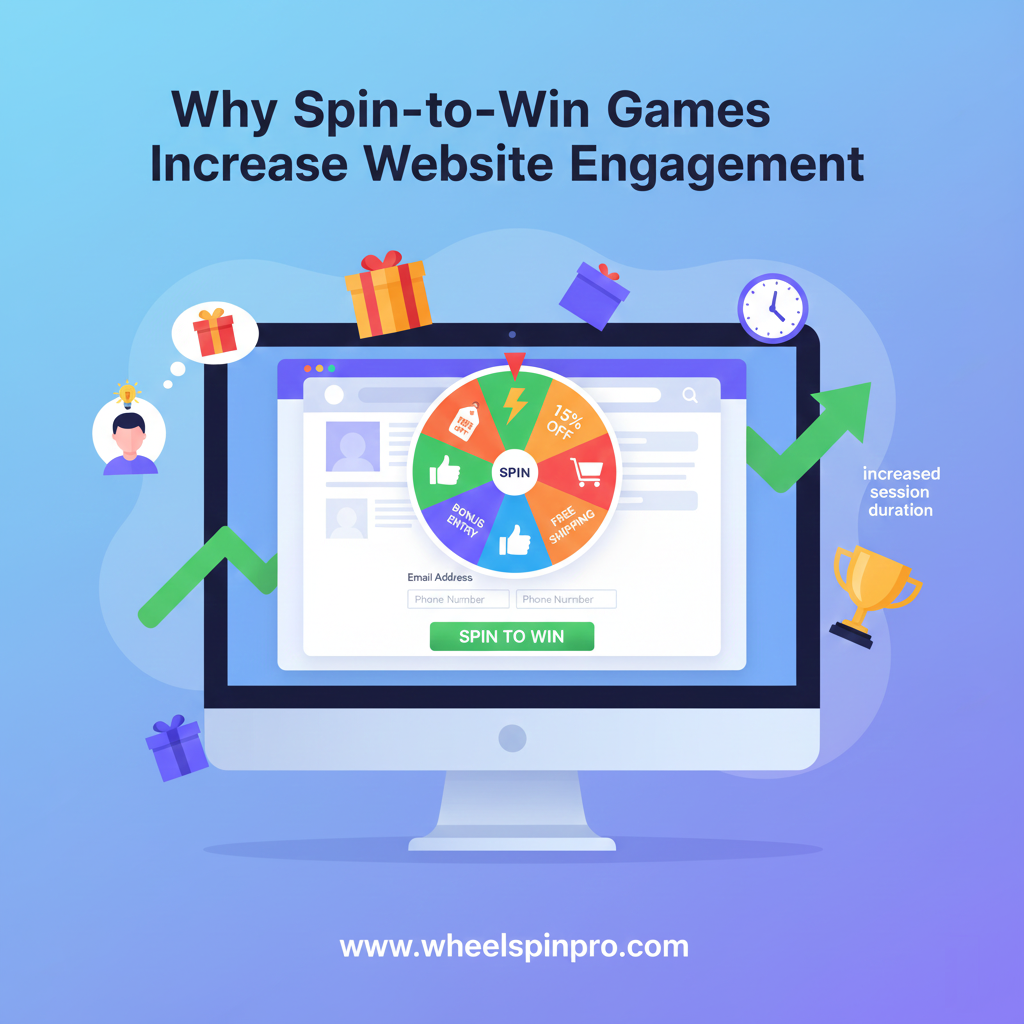
Why Spin-to-Win Games Increase Website Engagement: The Behavioral Science Explained
The average website visitor makes a stay-or-leave decision within eight seconds. Most engagement tools try to interrupt that decision with a better offer. Spin-to-win games change the question entirely — by giving visitors something to do before they decide.
Website engagement is both simpler and harder than most marketers treat it. Simpler because the underlying psychology is well-understood — humans engage with things that are interactive, unpredictable, and rewarding. Harder because most website experiences offer none of those three things.
A product page is not interactive. A signup form is not unpredictable. A 10% discount banner is not rewarding in any experiential sense — it is just a static numerical claim that the visitor has no reason to feel invested in.
Spin-to-win games systematically replace all three passive elements with their active equivalents. They convert browsing into doing, certainty into anticipation, and passive offers into earned rewards. The result is measurably higher engagement — not because the wheel is clever, but because the underlying behavioral mechanics are operating as intended.
This article explains those mechanics precisely, maps them to the specific engagement metrics they affect, and provides a framework for deploying spin-to-win correctly across different website contexts.
What "Website Engagement" Actually Measures — and Why Most Sites Fail at It
Before examining how spin-to-win games affect engagement, it's worth being precise about what engagement means in measurable terms. Marketers often use "engagement" loosely, but website analytics offer specific, concrete signals:
| Engagement Metric | What It Measures | Industry Benchmark |
|---|---|---|
| Bounce rate | % of visitors who leave without any interaction | 41–55% (varies by industry) |
| Average session duration | Time spent on site per visit | 2–4 minutes (e-commerce) |
| Pages per session | Depth of exploration per visit | 1.8–3.5 pages |
| Interaction rate | % of visitors who click, scroll, or act | Highly variable; low by default |
| Lead conversion rate | % of visitors who submit contact information | 1–5% (standard forms) |
| Return visit rate | % of visitors who return within 30 days | 25–35% (retail) |
Most websites perform at or below these benchmarks because the default web experience is fundamentally passive. Visitors arrive, scan text, view images, and depart — without any moment that required or invited their active participation. Engagement without interaction is not engagement; it is observation.
Spin-to-win games address this at the structural level. They insert a mandatory interactive moment into a passive browsing experience — and the behavioral mechanics of that interaction affect every metric in the table above.
The Five Behavioral Mechanisms That Drive Spin-to-Win Engagement
Spin-to-win games are often described as "gamified" — but that label obscures what is actually happening psychologically. There are five distinct behavioral mechanisms at work, each affecting engagement through a different pathway:
1. Pattern Interruption and Attention Capture
The human attention system is designed to filter out static, predictable stimuli and respond to novel, dynamic ones. This is why banner ads stopped working — once users learned to predict their location and content, the visual cortex began filtering them out automatically, a phenomenon documented as "banner blindness" in eye-tracking research.
A spin wheel appearing on a page is visually and behaviorally novel — it is animated, interactive, and doesn't match the category of "ad" that users have learned to ignore. This pattern interruption forces a genuine attention response before any conscious decision about engagement is made. The visitor sees and processes the wheel before their ad-filtering instinct has categorized it.
2. Dopamine Anticipation: The Neurological Engine
Neuroscience research by Wolfram Schultz established that dopamine release — the brain's primary motivation signal — peaks not when a reward is received, but during the period of uncertain anticipation before the outcome is known. This is why the seconds before a coin flip, a lottery draw, or a spinning wheel are subjectively more engaging than the moment the result is announced.
In a spin-to-win context, this means the most neurologically engaging moment of the entire website visit is the spin itself — a three-to-five second window of genuine uncertainty that the visitor initiated and is invested in. No static content on the page can replicate this: it requires genuine unpredictability and an outcome the user cares about.
3. Variable Ratio Reinforcement
Variable ratio reinforcement — where rewards are delivered on an unpredictable schedule — is the most powerful schedule of reinforcement identified in behavioral psychology. It is the mechanism behind slot machines, social media notifications, and any interactive system designed for sustained engagement.
In a spin-to-win game, the variable element is which reward the user receives (even when every outcome is a win), combined with the uncertainty of which segment the wheel will land on. This combination produces a stronger engagement response than a fixed offer of identical monetary value — because the unpredictability of the outcome creates the same psychological pull as any other variable ratio system.
Critically, this mechanism also explains why spin-to-win visitors are more likely to return for future promotions: variable ratio reinforcement systems produce high resistance to extinction — meaning participants continue engaging even when rewarded less frequently than they expect.
4. The IKEA Effect and Earned Ownership
Research by Norton, Mochon, and Ariely established the IKEA Effect: people assign significantly higher value to outcomes they actively participated in creating, compared to identical outcomes delivered passively. The name comes from the finding that furniture assemblers value their creations more highly than buyers of pre-assembled equivalents — despite the product being identical.
In spin-to-win mechanics, the user actively initiates the spin. They do not receive a discount — they win one. This active participation creates a sense of earned ownership over the reward that a passively served discount code cannot produce. The result is higher perceived value, stronger purchase intent, and lower abandonment between reward receipt and redemption.
5. Commitment and Consistency
Cialdini's principle of commitment and consistency establishes that people who take a small, voluntary action feel psychologically compelled to maintain consistency with that action. Entering an email address and clicking "Spin" is a voluntary commitment — and it creates forward momentum toward redemption that passive exposure to an offer does not.
This is why spin-to-win lead quality consistently exceeds standard form lead quality: users who spun made a deliberate choice to engage, which correlates with higher purchase intent and lower unsubscribe rates compared to users who submitted a form without the gamified engagement step.
How Spin-to-Win Affects Each Engagement Metric Specifically
Bounce Rate
A visitor who sees a spin wheel appearing on page load — or on exit intent — has a decision interruption before they leave. The pattern interruption mechanism means the wheel captures attention before the bounce decision is made. The anticipation mechanism means that once a visitor initiates a spin, they will not leave before seeing the result. Combined, these produce measurable bounce rate reductions of 10–25% in documented e-commerce deployments.
Session Duration
Session duration is directly extended by the spin interaction itself (3–5 seconds minimum), the reward reveal sequence (5–10 seconds), and the post-reward consideration phase where visitors decide whether to redeem immediately. For visitors who redeem a discount during the same session, session duration extends further as they browse products to apply it to — a secondary engagement effect with direct revenue implications.
Lead Capture Rate
This is the most consistently documented engagement improvement. Standard email popup conversion rates of 1–3% compare to spin-to-win conversion rates of 5–15% across documented case studies — a 3x to 8x improvement. The mechanism is the value exchange framing: "spin to win" presents the email submission as the cost of an interactive experience, rather than the cost of receiving a promotional message nobody asked for.
Lead Quality
Beyond quantity, spin-to-win leads show measurably different behavioral profiles from standard form leads. Because they engaged voluntarily with the brand before submitting their contact details, they have already demonstrated curiosity and purchase consideration. Open rates, click-through rates, and conversion rates on follow-up email sequences are consistently higher for spin-to-win-captured leads — making list quality, not just list size, a documented benefit.
Brand Recall
Experiential memory research shows that interactive moments — where users actively do something — are disproportionately retained compared to passive content consumption. A visitor who spun a wheel on a website will remember that website more vividly than one who simply read a product page, even if the session duration was identical. This brand recall effect has downstream benefits for return visit rates and direct traffic growth.
Where Spin-to-Win Works Best: Platform-by-Platform Analysis
When Spin-to-Win Reduces Engagement: Deployment Mistakes to Avoid
Spin-to-win games are not universally effective — they are effective when deployed correctly, and actively harmful to engagement when deployed poorly. These are the most common failure modes:
- Immediate page-load triggers — appearing before the visitor has formed any intent produces high dismissal rates and increases short-session bounces. Exit-intent or 15–30 second delays consistently outperform immediate triggers.
- Repeated exposure to the same visitor — a spin wheel that reappears on every visit rapidly shifts from engaging to annoying. Set frequency caps so each visitor sees the wheel once per session, or once per defined period.
- Loss segments ("Better luck next time") — as covered in our spin wheel mechanics guide, loss segments damage the perceived fairness that drives engagement. Every segment should deliver some value.
- Mismatched reward value — a spin wheel offering rewards clearly worth less than the personal information required to access it breaks the value exchange contract. The reward must feel worth the data.
- Friction in reward redemption — a complex multi-step redemption process between winning and using the reward captures the email but loses the conversion. One-click redemption is the benchmark.
- Visual inconsistency with the brand — a spin wheel that looks like it was copy-pasted from a different brand signals low quality and undermines the credibility the wheel was supposed to build.
- Exit-intent or 20–30 second delay trigger
- All segments deliver genuine value (tiered rewards, no loss segments)
- Email-only entry gate — no name, no phone number required
- On-screen reward delivery immediately after spin
- Confirmation email with single-click redemption path sent within 60 seconds
- Frequency cap of once per visitor per 30 days
- Visual design matches brand color palette and typography
How to Measure the Engagement Impact of Your Spin-to-Win Game
Deploying a spin wheel without measuring its impact is how organizations end up with anecdotal results rather than actionable data. These are the metrics to track — and how to attribute them correctly:
Direct Metrics (Attributable Directly to the Wheel)
- Spin rate — percentage of visitors who see the wheel and initiate a spin. Benchmark: 30–50% of those who see it. Below 20% suggests trigger timing or visual design problems.
- Completion rate — percentage of spin initiators who submit their email and complete the interaction. Should be above 80%; drop-off at this stage indicates entry gate friction.
- Reward redemption rate — percentage of spin winners who use their reward within the session or within 48 hours. This is the true conversion metric, not the spin completion rate.
Indirect Metrics (Influenced by the Wheel)
- Session duration on pages with the wheel — compare before and after deployment on the same pages
- Bounce rate on trigger pages — monitor the specific pages where the wheel appears; a properly timed wheel should reduce bounce rate on those pages
- Email list open and click rates — segment spin-to-win-captured leads separately and compare engagement rates to standard form leads over 30, 60, and 90 days
- Revenue per visitor on wheel-active pages — the most complete single metric for spin wheel ROI in e-commerce contexts
The A/B Testing Framework
Before attributing engagement changes to the spin wheel, run a controlled A/B test: identical pages with and without the wheel, equal traffic split, same measurement period. Most analytics platforms support this natively. The comparison should measure all six engagement metrics from the table above — not just conversion rate — to capture the full engagement impact across the visitor journey.
Engagement vs. Conversion: Understanding the Difference
One of the most common misapplications of spin-to-win games is treating them as purely a conversion tool — optimizing purely for email capture rate while ignoring the engagement context. Engagement and conversion are related but distinct objectives, and over-optimizing for one can harm the other.
A spin wheel optimized purely for maximum email capture — with a highly prominent trigger, aggressive re-display frequency, and pressure to spin — will produce a high email list growth rate and a low-quality, high-unsubscribe list. The conversions are technically happening, but the engagement the tool was supposed to build is being undermined by the implementation.
A spin wheel optimized for engagement — with appropriate trigger timing, genuine reward value, and a brand-consistent experience — produces a lower raw capture rate but a significantly more valuable list, a stronger brand impression, and measurably better downstream conversion on follow-up sequences.
The distinction matters because the two optimization paths produce fundamentally different outcomes for the same nominal metric. Engagement is the mechanism; conversion is the result. Optimize the mechanism, and the results follow. Optimize the result directly, and you typically break the mechanism.
Using WheelSpinPro to Improve Website Engagement
WheelSpinPro is built for the full range of spin wheel engagement use cases — from marketing lead capture to event prize draws to everyday decision tools — with the features that determine whether a deployment performs or underperforms:
- Customizable segment structure — set reward tiers, control segment sizes (and therefore probabilities), and ensure every segment delivers genuine value
- Brand-consistent visual design — match colors, typography, and visual style to your existing site identity so the wheel feels like part of your brand, not an external widget
- Multiple spinner formats — Classic Wheel for standard draws, Lucky Box for grid-format reward reveals, Center Spin for live event and large-screen contexts
- Results tracking — log spin outcomes for prize draws, recurring campaigns, and multi-session event use
- Device compatibility — works on desktop, tablet, and mobile without performance degradation; touch-spin works natively on mobile screens
- No installation or account required to spin — zero friction for visitors encountering the wheel for the first time
For a deeper look at spin wheel mechanics for lead generation specifically, see our guide on how spin wheel popups generate leads.
Final Thoughts: Engagement Is a Behavioral Problem, Not a Content Problem
The standard response to low website engagement is better content — more detailed product pages, stronger copy, better imagery. These improvements have real value. But they address the quality of the passive experience without changing its fundamental passivity.
Spin-to-win games address the structural problem: they convert a passive, observation-based website experience into an active, participation-based one — even briefly. And that brief participation, governed by the behavioral mechanics of anticipation, variable reinforcement, and earned reward, produces engagement effects that persist through the session and beyond.
The psychology here is not new. The mechanisms were documented in behavioral research decades before digital marketing existed. What's new is the ease of deploying those mechanisms in a browser-based, branded, measurable format — and the clarity we now have about when and how that deployment produces genuine engagement improvement rather than inflated vanity metrics.
Used correctly, a spin-to-win game is not a gimmick layered on top of your website. It is a behavioral architecture change — one that makes your site more engaging at a fundamental level, for the visitors most likely to become customers.
📎 Related Articles on WheelSpinPro
- What Is a Spin the Wheel Game? How It Works & Why It Converts — full technical and psychological breakdown of spin wheel mechanics
- How Spin Wheel Popups Generate Leads — implementation guide for marketing and lead capture contexts
- Fair Giveaways and Contests Using Online Spin Wheels — applying spin wheels for trust-building prize draws
- Spin Wheels vs. Manual Decision Making — the cognitive science behind randomization and perceived fairness
- WheelSpinPro Features — full overview of customization, deployment, and analytics tools
Frequently Asked Questions
📚 External References
- Schultz, W. (1998). Predictive Reward Signal of Dopamine Neurons — Journal of Neurophysiology, 80(1). Primary neuroscience research on dopamine anticipation: reward signals peak during uncertain anticipation, not at reward delivery. American Physiological Society
- Norton, M. I., Mochon, D., & Ariely, D. (2012). The IKEA Effect: When Labor Leads to Love — Journal of Consumer Psychology, 22(3). Research establishing that active participation in creating an outcome increases perceived value of the result. ScienceDirect
- Benway, J. P. & Lane, D. M. (1998). Banner Blindness: Web Searchers Often Miss "Obvious" Links — Internetworking, 1(3). Foundational eye-tracking research documenting how users learn to filter out static, predictable web advertising — and why animated, interactive elements bypass this filter. Rice University