What Is a Spin the Wheel Game? How It Works, Why It Converts, and Where to Use It
A spin the wheel game is simultaneously one of the oldest engagement mechanics and one of the most effective digital conversion tools available today. Understanding why it works — not just how it looks — is the difference between deploying it effectively and wasting the traffic it touches.
"Spin the wheel" has existed in some form for centuries — from carnival prize wheels to television game shows to casino roulette. The format endures because it exploits a specific, deeply wired aspect of human psychology: the tension between uncertainty and anticipated reward.
In its modern digital form, a spin the wheel game applies this same psychology to marketing, education, events, and everyday decisions — turning a passive interaction (visiting a page, attending a meeting, sitting in a classroom) into an active moment of shared anticipation and participation.
This article explains what spin the wheel games actually are across their different formats, the psychological mechanics that make them effective, how they work technically, where they are most appropriately used, and what distinguishes a well-implemented spin wheel from a poorly deployed one.
What Is a Spin the Wheel Game? (A Precise Definition)
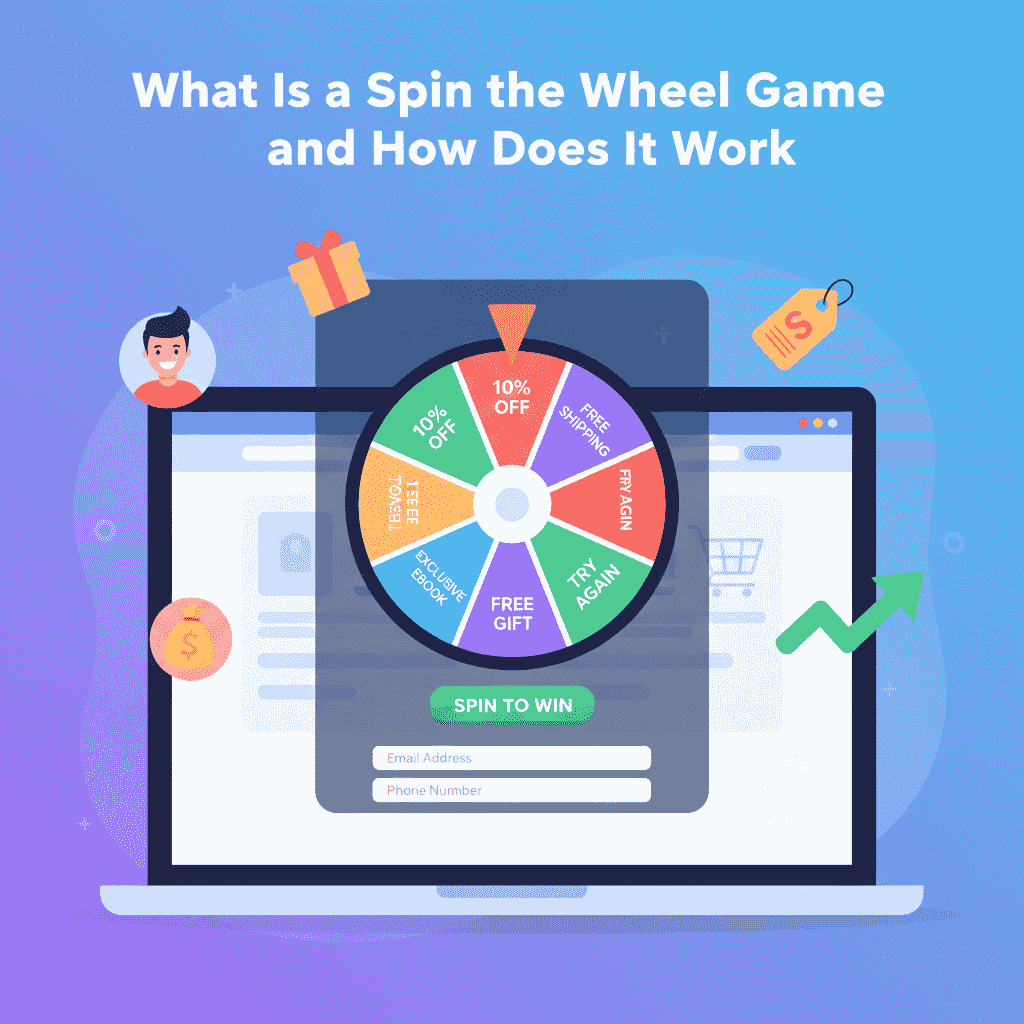
A spin the wheel game is a randomized selection mechanism presented as an interactive spinning wheel, where the outcome — a prize, a task, a name, a question, or any other defined result — is determined by where the wheel stops after spinning.
The wheel is divided into segments, each representing a possible outcome. When spun, the wheel rotates and decelerates to rest on a segment selected by a pseudo-random number generator (PRNG) — a computational algorithm designed to produce statistically uniform, unpredictable results. Each segment's probability of selection is proportional to its size relative to the total wheel circumference.
This definition covers several distinct use types that are commonly grouped under the same name but serve different functions — an important distinction that affects how you design and deploy the tool.
The Three Types of Spin the Wheel Games (And How They Differ)
"Spin the wheel" is used to describe at least three structurally different applications. Understanding the distinction matters because each has different design requirements, success metrics, and best practices.
| Type | How It Works | Primary Goal | Who Uses It |
|---|---|---|---|
| Marketing / Spin-to-Win | Visitors enter their contact info to spin for a discount, offer, or prize. The wheel reveals a reward they receive immediately. | Lead capture and conversion | E-commerce brands, SaaS, retailers |
| Decision / Random Picker | User loads any custom options into the wheel and spins to select one at random. Used for choices, task assignment, and group decisions. | Fair, fast, neutral selection | Teams, teachers, households, event organizers |
| Prize Draw / Raffle | Participant names or entries are added to the wheel. A spin selects the winner in front of the full audience. | Transparent, trusted winner selection | Brands, educators, event organizers |
WheelSpinPro covers all three types — and each format (Classic Wheel, Center Spin, Lucky Box, Coin Toss, Dice Roll) is designed for specific use contexts within these categories. The rest of this article covers each type in detail.
How a Spin the Wheel Game Works: The Technical Mechanics
Understanding what happens under the hood matters for two reasons: it explains why the outcome is genuinely random (building user trust), and it clarifies the design levers that control probability when weighted outcomes are needed.
The Randomization Engine
When a user clicks "spin," the software calls a pseudo-random number generator to select a stopping position — expressed as an angle between 0 and 360 degrees. This angle determines which segment the wheel lands on. A well-implemented PRNG produces results from a statistically uniform distribution, meaning every degree on the wheel has an equal probability of being selected before segment size is factored in.
Segment probability is therefore determined by segment size: a segment occupying 10% of the wheel's circumference has a 10% chance of selection. This is the mechanism used to implement weighted rewards in marketing spin wheels — a "20% off" coupon occupying a larger segment simply has a proportionally higher probability of being selected.
The Animation Layer
The physical appearance of spinning — the wheel rotating fast, decelerating, and stopping — is an animation that runs after the random outcome has already been determined. The result is selected computationally in milliseconds; the spin animation then plays to that predetermined stopping point. This is identical to how slot machine displays work: the outcome is set before the reels spin, and the spinning animation is a UX layer designed to build anticipation.
This is not deceptive — the underlying randomization is genuine. The animation is simply the human-readable presentation of a numerical result, designed to create the shared anticipation experience that makes the format engaging.
The Marketing Spin-to-Win Flow
The wheel appears based on a defined trigger: page load after a time delay, exit intent (cursor moving toward browser close), scroll depth threshold, or a specific user action (adding to cart, reaching a landing page). Exit intent triggers typically produce the highest conversion rates because they intercept users who would otherwise leave without converting.
Before spinning, users enter an email address or phone number. This is the lead capture mechanism — the spin is the value exchange. The psychological framing is critical: the user is earning a spin by sharing their contact details, rather than submitting to a form. Same transaction; fundamentally different emotional experience.
The user initiates the spin — this active participation is deliberate. Studies on commitment and consistency (Cialdini's influence framework) show that people who actively initiate an action feel greater ownership of the outcome and are more likely to follow through on the reward.
The wheel slows and stops on a reward segment. The reveal moment is the peak of the anticipation arc — the highest-engagement second of the entire interaction. Well-designed spin wheels use sound effects and visual emphasis at this moment to maximize the perceived value of the reward, regardless of its monetary value.
The reward — a discount code, a free shipping offer, an exclusive download — is delivered immediately via the same screen and optionally to the provided email. Instant delivery is essential: any delay between winning and receiving breaks the psychological momentum that drives immediate conversion.
The Psychology Behind Why Spin Wheels Work (And Why Static Forms Don't)
The spin wheel's effectiveness is not primarily about the prize. A 10% discount delivered through a standard popup produces a measurably different response than the same 10% discount delivered through a spin wheel — because the engagement mechanics activate psychological systems that static forms cannot reach.
Variable Ratio Reinforcement
The most powerful finding in behavioral psychology regarding engagement is variable ratio reinforcement: rewards delivered on an unpredictable schedule produce stronger and more persistent behavioral responses than fixed or predictable rewards. This is why slot machines, social media notifications, and spin wheels are all structurally engaging — the reward might come, and the uncertainty of when keeps attention engaged until it does.
In a marketing spin wheel, the variable element is which reward the user receives, not whether they receive one. But the psychological mechanism is identical: uncertainty about the outcome maintains engagement through the spin and increases the perceived value of whatever is received.
The Endowment Effect and Earned Rewards
When users spin a wheel themselves — rather than passively receiving a discount code — they experience the reward as something they earned through action. This activates the endowment effect: people assign higher value to things they have a sense of ownership over. A 15% discount "won" on a spin wheel is psychologically more valuable than the same 15% passively offered, even when the monetary value is identical.
Anticipation and Dopamine
Neuroscience research on reward anticipation shows that dopamine release — the brain's primary motivation and pleasure signal — peaks not at the moment of receiving a reward, but during the period of uncertain anticipation before the outcome is known. The seconds while the spin wheel rotates are neurologically the most engaging moment of the entire interaction. This is why the spin animation duration matters: too short and the anticipation arc is truncated; too long and it becomes frustrating.
Gamification and Perceived Fairness
By framing a marketing offer as a game with a random outcome, spin wheels trigger a fairness perception that static promotions cannot. Users feel they had a genuine chance at a better reward — even if the reward probabilities are weighted. This perceived fairness reduces the psychological resistance that causes users to dismiss or close traditional promotional popups.
Where Spin the Wheel Games Are Used: Industry-by-Industry
What Separates a Well-Designed Spin Wheel from a Poorly Deployed One
The popularity of spin wheel tools means they are widely deployed — and frequently deployed badly. A poorly designed spin wheel can damage conversion rates, user trust, and brand perception. Here are the design and implementation principles that determine whether a spin wheel helps or hurts.
Reward Design: Calibrate the Win Probability
The most common mistake in marketing spin wheels is over-indexing on the grand prize. A wheel where 90% of the segments say "Better luck next time" does not feel fair or fun — it feels like a rigged carnival game, which triggers exactly the distrust response the spin wheel was designed to avoid. Best practice: ensure every segment delivers something of genuine value, even if the tiers vary significantly. A wheel where every outcome is a win (just different levels of win) produces higher satisfaction and better conversion than one with frequent loss segments.
Trigger Timing: Don't Interrupt Too Early
Exit-intent triggers outperform immediate page-load triggers because they reach users at the moment of departure — when the alternative is losing them entirely — rather than interrupting them before they've formed any intent. Time-delay triggers (15–30 seconds) perform better than immediate triggers for the same reason: the user has had time to develop some investment in the page before the offer appears.
Entry Gates: Keep Friction Minimal
Email address only. No name, no phone number (unless phone is essential for delivery), no account creation. Every additional field required before spinning increases abandonment at the gate. The psychological contract of the spin wheel format — "give me your email, get a spin" — breaks down the moment the request feels like a full signup form.
Reward Delivery: Instant, Frictionless, Memorable
Deliver the reward on the same screen, immediately after the spin resolves. Send a confirmation email with a clear, one-click redemption path. Set a genuine expiry (24–48 hours for discount codes creates urgency without feeling manipulative). A reward that requires five steps to redeem produces far lower actual conversion than the spin-to-claimed-reward rate suggests.
- Triggering the wheel immediately on page load before the user has any context
- Requiring extensive personal information before the spin (more than email)
- Using "Better luck next time" or "No win" segments — these damage trust
- Delivering rewards via a multi-step process that requires account creation
- Using a wheel design that looks inconsistent with the brand (signals low credibility)
- Setting reward expiry periods that are too short to feel fair (under 12 hours)
The Decision Spin Wheel: When It's Not About Marketing at All
A substantial portion of spin wheel use has nothing to do with lead capture or marketing. The decision spin wheel — where users load any custom options and spin for a neutral random selection — is a separate product category with different success metrics and a different user base.
Decision wheels are used when all options are acceptable but a choice is still needed — and when the cost of deliberation (time, social friction, cognitive fatigue) exceeds the value of selecting any one specific option. This includes:
- Group deadlocks — teams stuck between equivalent choices after legitimate deliberation
- Recurring fair rotation — task assignment, meeting facilitation, presentation order
- Low-stakes daily decisions — meals, activities, entertainment — where mental energy is better preserved for higher-value choices
- Transparent participant selection — classrooms, events, contests where the process must be visibly neutral
The decision wheel's value is not gamification — it is cognitive offloading. By delegating a decision to a neutral mechanism, the user preserves mental bandwidth and eliminates the social dynamics that make many group decisions slow, biased, and contentious.
Spin Wheel vs. Other Lead Capture and Engagement Methods
| Method | Average Conversion Rate | User Experience | Trust Level | Best For |
|---|---|---|---|---|
| Standard email popup | 1–3% | Interruptive, passive | Low (feels like spam) | Established audiences with existing brand trust |
| Static discount banner | 0.5–2% | Passive, ignored | Medium | Persistent awareness, not conversion |
| Quiz or assessment lead magnet | 3–8% | Engaging but time-intensive | High | B2B and high-consideration purchases |
| Spin-to-Win Wheel | 5–15% | Interactive, fun, low friction | High (visibly fair) | E-commerce, events, broad consumer audiences |
| Exit-intent offer (non-wheel) | 2–5% | Interruptive at departure | Medium | Last-chance retention for abandoning visitors |
Conversion rate ranges vary significantly by industry, offer quality, traffic source, and implementation quality. The figures above reflect documented ranges from e-commerce and SaaS case studies and should be treated as benchmarks rather than guarantees. A poorly implemented spin wheel will underperform a well-implemented standard popup.
WheelSpinPro: A Spin Wheel Built for Every Use Type
WheelSpinPro is designed to serve all three spin wheel use types — marketing draws, decision tools, and transparent prize draws — with specialized formats for each:
- Classic Wheel — the standard multi-option spinner, ideal for decision-making, participant selection, and custom prize draws with any number of segments
- Center Spin — designed for large-screen display at live events, classrooms, and projector environments
- Lucky Box — a grid-format prize reveal alternative to the wheel, suited for multi-tier reward structures and brand activations
- Coin Toss and Dice Roll — binary and numbered randomization for decisions that don't require a full wheel format
All formats are browser-based (no installation required), work across devices including tablets and interactive whiteboards, support pre-built saveable configurations, and include results history tracking — making them suitable for both one-time use and recurring deployment in meetings, classrooms, and ongoing promotional campaigns.
For more on using spin wheels specifically for lead generation, see our guide on how spin wheel popups generate leads.
Final Thoughts: The Spin Wheel Is a Psychology Tool, Not Just a Visual Effect
The reason spin the wheel games have persisted — from carnival midways to television game shows to digital marketing — is not nostalgia. It is because the format reliably activates a specific cluster of psychological responses: anticipation, perceived fairness, earned reward, and shared uncertainty. These responses are not optional extras — they are the mechanisms that produce engagement, trust, and conversion.
Understanding this is what separates organizations that deploy spin wheels effectively from those that treat them as a novelty that occasionally works. A spin wheel designed around its psychological mechanics — with calibrated reward structures, appropriate trigger timing, minimal entry friction, and instant reward delivery — consistently outperforms static alternatives by a measurable margin.
Whether you are using it to capture leads, run a fair classroom, draw a trusted giveaway winner, or simply decide where to eat tonight — the spin wheel works because the mechanics beneath it work. The spinning animation is just how those mechanics become visible.
📎 Related Articles on WheelSpinPro
- How Spin Wheel Popups Generate Leads — deep dive into marketing spin wheel implementation and conversion optimization
- Fair Giveaways and Contests Using Online Spin Wheels — prize draw transparency and trust mechanics
- Spin Wheels vs. Manual Decision Making — the cognitive science behind why randomization outperforms human selection
- Spin Wheels for Classrooms and Online Learning — educational applications and participation equity research
- WheelSpinPro Features — full overview of spinner formats, customization, and use-case applications
Frequently Asked Questions
📚 External References
- Cialdini, R. B. (2006). Influence: The Psychology of Persuasion — Harper Business. Foundational work on commitment, consistency, and the psychological mechanisms behind interactive engagement and perceived earned value. HarperCollins
- Schultz, W. (1998). Predictive Reward Signal of Dopamine Neurons — Journal of Neurophysiology, 80(1). Primary neuroscience research establishing that dopamine release peaks during uncertain anticipation rather than at reward delivery — the core mechanism behind spin wheel engagement. American Physiological Society
- Thaler, R. H. (1980). Toward a Positive Theory of Consumer Choice — Journal of Economic Behavior & Organization, 1(1). Foundational paper establishing the endowment effect — why actively earned rewards are perceived as more valuable than passively received ones of equivalent monetary value. ScienceDirect