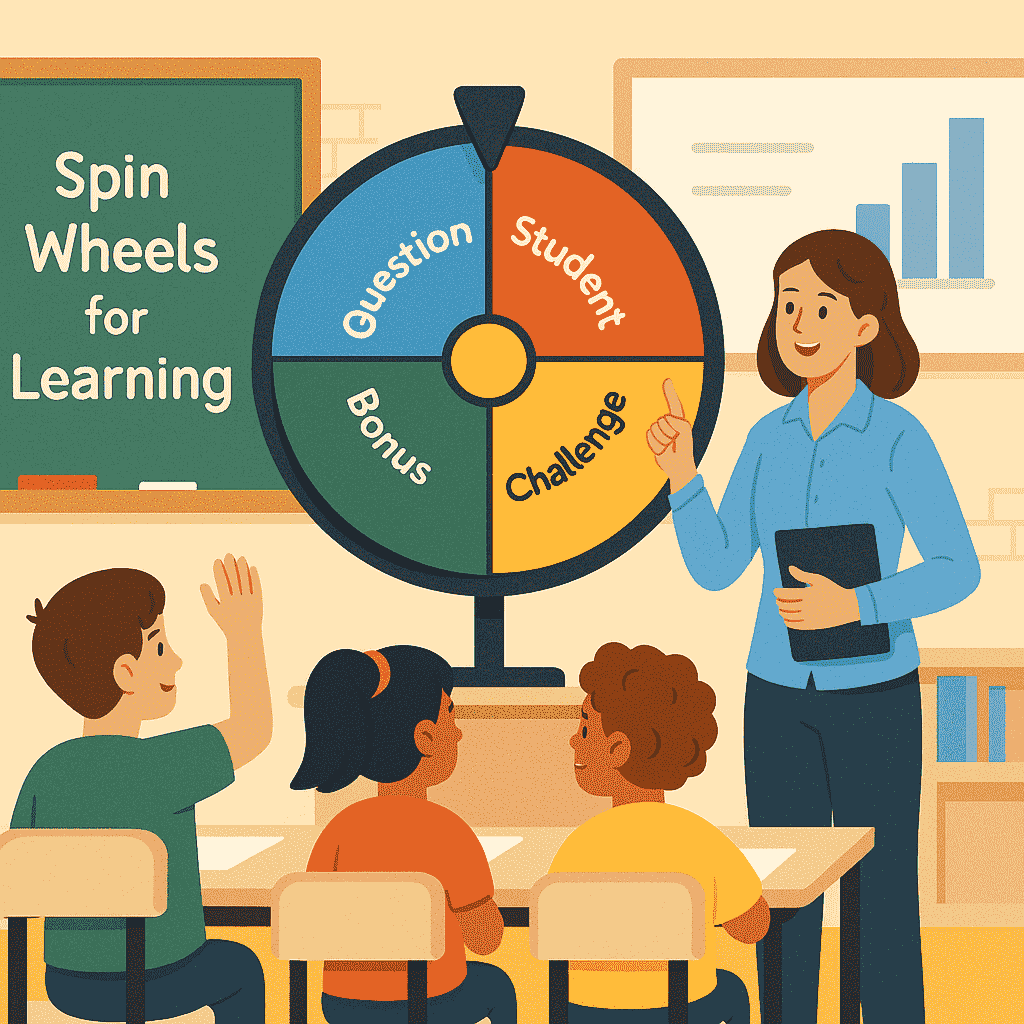
Spin Wheels for Classrooms and Online Learning: The Evidence-Backed Case for Random Student Engagement
The same four students raise their hands. The rest of the class quietly disengages. This pattern isn't a discipline problem — it's a participation architecture problem. Here's how a digital spin wheel fixes it, and why the research backs it up.
Student engagement is among the most researched — and most persistently difficult — challenges in education. The data is not encouraging: a 2022 Gallup survey found that only 34% of U.S. students in grades 5–12 reported feeling engaged in school. By high school, that number falls further. In online and hybrid learning environments, it drops further still.
Most proposed solutions involve curriculum redesign, technology integration, or teacher training — all valuable but resource-intensive. What gets less attention is a simpler, structural problem: most classroom participation systems are architecturally unfair, and students know it.
When participation is voluntary, the same confident students dominate every discussion. When teachers manually select students, unconscious bias quietly determines who gets called on. When online sessions offer no interactivity, students become audience members rather than participants.
A digital spin wheel is a low-tech, high-impact intervention that addresses the structural root of these problems — not by making lessons more complex, but by making participation visibly fair, unexpectedly exciting, and consistently distributed.
Why Student Engagement Is a Learning Outcome, Not Just a Classroom Atmosphere Issue
Engagement is not simply about whether students look attentive. Educational psychology distinguishes three dimensions of engagement, each with different effects on learning outcomes:
| Engagement Type | What It Means | Effect on Learning |
|---|---|---|
| Behavioral engagement | Active participation in tasks, discussions, and activities | Higher task completion, better academic performance |
| Cognitive engagement | Deep processing of material, not just passive reception | Better retention, stronger conceptual understanding |
| Emotional engagement | Sense of belonging, interest, and investment in the class | Reduced dropout rates, higher intrinsic motivation |
Research by Fredricks, Blumenfeld, and Paris (2004) in the Review of Educational Research established that all three dimensions are necessary for meaningful learning — and that behavioral engagement, the most directly observable, has cascading effects on the other two. When a student answers a question in front of peers, they are not just participating behaviorally — they are processing material cognitively and receiving social validation emotionally.
This is why classroom participation systems matter far beyond classroom management. They are learning infrastructure — and infrastructure that serves only the most confident students leaves the majority undertrained and underconfident.
The Participation Equity Problem: Why "Raise Your Hand" Fails Most Students
The voluntary hand-raising model has been the default classroom participation system for over a century. Its persistence is largely inertial, because the evidence against it has been accumulating just as long.
In a typical classroom discussion where students volunteer answers, research consistently finds that roughly 20–30% of students account for 70–80% of all verbal participation. This is not random variation — it follows predictable patterns:
- Gender patterns — studies show male students volunteer responses at higher rates in mixed-gender classes, regardless of knowledge level
- Personality patterns — extroverted students dominate verbal participation independent of academic ability
- Socioeconomic patterns — students from lower-income backgrounds raise their hands less frequently, even when they know the answer, due to higher anxiety around public error
- Cultural patterns — students from cultures that emphasize humility or collective over individual performance participate less in Western volunteer-based models
The result: in a voluntary participation model, academic confidence — not academic knowledge — determines who develops verbal fluency, teacher relationship, and self-efficacy through classroom interaction. The students who most need practice participating are the ones who practice least.
How Random Selection Repairs This
Cold-call teaching — randomly selecting students to respond rather than waiting for volunteers — has a substantial body of educational research behind it. Studies at both K–12 and university levels consistently find that random selection produces:
- Higher pre-class preparation rates (students study more when they know they may be called on)
- More equitable verbal participation across gender, personality, and cultural lines
- Stronger retention of material for students who are called on and for those who listen
- Reduced anxiety over time — initially higher, but declining as students normalize the expectation
A digital spin wheel makes cold-call selection visually transparent and emotionally neutral. Students don't feel singled out by the teacher — they feel selected by the wheel. This subtle psychological shift is significant: it removes the social awkwardness of being individually chosen and replaces it with shared participation in a fair, public process.
How Teachers Actually Use Spin Wheels: 8 Classroom Applications
A spin wheel in the classroom is more versatile than it initially appears. Here are the eight most effective applications, ranked from simplest to most creative:
The Online and Hybrid Learning Problem — And Why It's Worse Than the Classroom Version
The participation equity problem that exists in physical classrooms is significantly amplified in online and hybrid learning environments. Several compounding factors are responsible:
Screen Fatigue and Passive Consumption Habits
Online learners default to a consumption mindset — the same posture they bring to watching videos or scrolling feeds. Without structural prompts to participate, the vast majority of students in a virtual session remain passive for its entire duration, even when they are paying some degree of attention.
Reduced Social Accountability
In a physical classroom, a student who is visibly disengaged creates a social signal that most students unconsciously avoid producing. Online, with cameras off and no physical presence, this social accountability disappears. The cost of disengagement becomes effectively zero.
The Hybrid Inequity Problem
In hybrid sessions — where some students are physical and others are remote — in-room students naturally receive more teacher attention, more impromptu interaction, and more social presence. Remote students experience the session as spectators of an in-room event rather than equal participants. This is not a technology problem. It is a participation architecture problem.
- It creates a shared interactive moment that all participants — physical and remote — experience simultaneously
- It reintroduces social accountability: if your name might come up next, you stay present
- It visually signals to remote participants that their engagement is expected and structurally equal
- It breaks the passive consumption posture with a moment of genuine unpredictability and shared attention
Teachers who use spin wheels in online sessions consistently report that they are one of the most effective single-tool interventions for recovering participation in disengaged virtual classes — precisely because they make engagement mandatory without making it feel punitive.
Spin Wheels for Classroom Management: The Positive Reinforcement Angle
Beyond participation, spin wheels have a well-documented application in classroom behavior management — specifically in positive reinforcement systems that research shows are significantly more effective than punitive approaches.
Behavior management research consistently supports reinforcement-based systems over consequence-based ones for sustainable behavior change in school settings. The core principle: students respond more reliably to the possibility of reward than to the certainty of consequence. A spin wheel adds a crucial element that pure reward charts lack — unpredictability.
Why Unpredictability Strengthens Reinforcement
Variable ratio reinforcement — where rewards are delivered randomly rather than on a fixed schedule — produces stronger and more persistent behavioral responses than fixed schedules, according to classical operant conditioning research dating from Skinner's foundational work. In classroom terms: a student who might win a reward from the wheel at any time stays engaged throughout the session, not just when they know a reward is coming.
- Participation reward wheel — students who answer questions or contribute earn entries; spin to select a winner at end of class
- Behavior milestone wheel — class earns a spin when a collective goal is met (e.g., full attendance, completing a challenge)
- Choice reward wheel — rather than a fixed prize, spin determines which privilege the winning student receives (extra free time, homework pass, seat choice)
- Random acts of recognition — spin weekly to select a student to receive a public acknowledgment or "star of the week" feature
How to Implement a Spin Wheel in Your Classroom: A Teacher's Step-by-Step Guide
Don't introduce the wheel for everything at once. Start with student name selection for one specific activity — Q&A during a review session is ideal. Students need to experience the process as fair and fun before it becomes routine.
Set up your student name wheel at the start of term and save it. Having to type names during class undermines the tool's value. A pre-built wheel takes five seconds to open and spin — that's the experience you want.
Introduce the wheel as a fairness tool, not a surveillance tool. "This ensures everyone gets an equal chance to participate" is a very different message from "I'll use this to catch you not paying attention." The framing shapes how students experience being selected.
For students with high participation anxiety, offer the option to pass once per session or to ask a classmate for help before answering. This maintains the fairness of random selection while reducing the performance pressure that makes some students dread being called.
The transparency of the spin is its educational value — students see it happen in real time and accept the result as fair. Share your screen first, then spin. A result announced without the visible spin carries no authority.
For extended projects or long-term rotation (presentation order, group leadership), track who has been selected and temporarily remove their names from the wheel until everyone has had a turn. This ensures fairness not just within a single spin but across an entire semester.
Addressing the Anxiety Question: Is Random Selection Stressful for Students?
This is the most common concern teachers raise when considering cold-call selection tools — and it deserves a direct, evidence-based answer.
Research on cold-call teaching acknowledges that initial anxiety is real. Students who have never been randomly selected in a classroom will experience a brief stress response the first few times. This is normal and, critically, transient.
Longitudinal studies of cold-call teaching methods — particularly from law school contexts where random selection has been standard practice for decades — consistently find that anxiety decreases significantly after the first 2–3 weeks as students normalize the expectation and develop confidence through repeated participation. What students fear in anticipation (being wrong in front of peers) rarely matches their actual experience (answering, attempting, or passing with no lasting social consequence).
The key mediating factors are teacher response and classroom norms. If a teacher responds warmly to wrong answers, if the classroom norm is that attempting is valued over being correct, and if re-directs are handled without judgment, the anxiety associated with random selection becomes a pathway to confidence rather than a barrier.
Why WheelSpinPro Works for Classroom Use
WheelSpinPro is designed for the practical constraints of real classroom environments — where setup time is limited, technical complications are costly, and the tool needs to work cleanly the first time, every time.
- Browser-based, no installation required — works on desktops, tablets, interactive whiteboards, and shared classroom computers without any software setup
- Pre-built and saveable wheels — create your student name wheel once at the start of term; reopen it in seconds for every subsequent class
- Multiple spinner formats — the Classic Wheel for standard name selection, Center Spin for large-screen classroom display, and Lucky Box for reward draws
- Results history tracking — log previous selections to ensure fair rotation across sessions and eliminate repeated picks
- Clean, distraction-free interface — screen-shares without visual clutter competing for student attention
- No login required — students don't need accounts; the teacher operates the tool entirely
The Bottom Line: Engagement Is Architecture, Not Motivation
The instinct when students are disengaged is to work harder on motivation — make the content more interesting, add more technology, increase the entertainment value of lessons. These efforts have value, but they address the symptom rather than the structure.
Participation equity is a structural problem. When 20% of students do 80% of the participating, the other 80% are not failing to be motivated — they are operating rationally within a system that doesn't require their engagement. Change the system, and engagement follows.
A spin wheel is one of the simplest, most immediate structural changes a teacher can make. It requires no curriculum redesign, no technology training, no additional budget, and no preparation beyond entering names. And in return, it produces fairer participation, higher attentiveness, more equitable skill development, and — consistently, across research contexts — better learning outcomes for the students who needed the most help engaging.
That's not a novelty. That's teaching infrastructure.
📎 Related Articles on WheelSpinPro
- Why Fair Decision-Making Matters — And How Randomization Fixes It — the psychology of procedural fairness and random selection
- How Spin Wheels Improve Team Productivity — the same participation principles applied in workplace meetings
- Spin Wheels vs. Manual Decision Making — the cognitive science behind why randomization outperforms human selection
- Try Center Spin — optimized for classroom display on projectors and interactive whiteboards
- WheelSpinPro Use Cases — full overview of educational and professional applications
Frequently Asked Questions
📚 External References
- Fredricks, J. A., Blumenfeld, P. C., & Paris, A. H. (2004). School Engagement: Potential of the Concept, State of the Evidence — Review of Educational Research, 74(1). Foundational framework for behavioral, cognitive, and emotional engagement dimensions. SAGE Journals
- Hattie, J. (2009). Visible Learning: A Synthesis of Over 800 Meta-Analyses Relating to Achievement — Routledge. Comprehensive meta-analysis establishing the effect size of student participation on academic outcomes. Routledge
- Dallimore, E. J., Hertenstein, J. H., & Platt, M. B. (2013). Impact of Cold-Calling on Student Voluntary Participation — Journal of Management Education, 37(3). Research on how cold-call teaching affects voluntary participation rates and anxiety over time. SAGE Journals