How Random Spin Wheels Improve Team Productivity — And Why It Actually Works
Slow decisions, uneven workloads, and disengaged meetings don't just waste time — they quietly erode team morale. A random spin wheel fixes all three, and the reason it works is grounded in organizational psychology, not novelty.
Most team productivity problems don't come from a lack of talent or effort. They come from decision friction — the invisible drag created every time a group needs to agree on who does what, what gets prioritized, or who speaks next.
This friction compounds daily. A five-minute debate over task assignment in a morning standup. A recurring feeling among certain team members that they always get the difficult work. A meeting where the same three people talk while everyone else stays quiet.
A random spin wheel addresses all of these — not by replacing human judgment, but by eliminating the specific moments where human judgment introduces bias, delay, and inequity.
This article explains the psychology behind why spin wheels work in workplace settings, where they deliver the most value, and how to implement them without making your team feel like they're at a game show.
The Three Productivity Problems Spin Wheels Actually Solve
Before examining the solution, it's worth being precise about the problems. Teams don't suffer from randomness — they suffer from three very specific failure modes in group decision-making:
| Problem | What It Looks Like | The Productivity Cost |
|---|---|---|
| Biased task distribution | The same reliable people get assigned hard tasks repeatedly | Burnout, resentment, skill stagnation in others |
| Decision delay | Groups debate low-stakes choices longer than necessary | Meeting overruns, lost momentum, delayed execution |
| Passive participation | The same voices dominate; others mentally check out | Wasted talent, groupthink, poor idea diversity |
A spin wheel is a direct, low-friction intervention for all three. Understanding why it works requires looking at what each problem actually costs.
Why Task Assignment Is More Biased Than Most Managers Realize
When a manager or team lead assigns tasks informally — through instinct, habit, or availability — they are not making neutral decisions. They are expressing a complex mix of affinity bias (assigning to people they trust most), availability heuristic (picking whoever comes to mind first), and performance stereotyping (defaulting to whoever did it well last time).
This is not a character flaw. It is a feature of how human cognition works under time pressure. But the downstream effects are real: research on workplace equity consistently shows that high performers who are repeatedly assigned challenging work experience accelerated burnout, while others on the same team develop more slowly due to fewer stretch opportunities.
What Fair Task Rotation Actually Delivers
- Skill development across the team — junior members get exposure to tasks outside their usual scope
- Reduced burnout in top performers — high-demand employees aren't always the default pick
- Higher perceived fairness — team members report greater satisfaction when task assignment feels neutral
- Better redundancy — more team members develop competence across critical tasks, reducing single points of failure
The Hidden Cost of Low-Stakes Decision Debates
Not all meeting time is created equal. Research from MIT's Sloan School of Management found that the average knowledge worker spends over 23 hours per week in meetings — and a significant portion of that time is spent on decisions that don't require extended deliberation.
These are symmetrical decisions: choices where all options are acceptable and the goal is resolution, not optimization. Who presents first. Which team goes next. What topic gets addressed at today's standup. Which idea gets prototyped this sprint when the team can't choose between two equally valid ones.
For these decisions, continued debate doesn't improve the outcome. It simply consumes time and generates social tension — because every additional minute of discussion makes it harder for anyone to accept an outcome that wasn't their preference.
"The longer a group debates a decision, the more entrenched each member becomes in their position — even when the options are functionally equivalent."
— Adapted from research on group polarization, Sunstein & Hastie, Wiser: Getting Beyond Groupthink to Make Groups Smarter
A spin wheel ends this loop instantly. It doesn't just save five minutes — it preserves the emotional equilibrium of the group by removing the human from the decision entirely. Nobody lost. The wheel decided.
Why Meetings Become Passive — And How Random Selection Reverses It
In any group of eight or more people, a reliable pattern emerges: two or three participants contribute the majority of comments, while the rest fall into passive observation. This is so consistent it has a name in organizational behavior research — participation inequality.
It's not that quieter team members have nothing to contribute. It's that the cost of speaking up (potential judgment, interrupting someone mid-thought, appearing unprepared) often exceeds the perceived benefit in the moment. Over time, this becomes a habit — and the meeting becomes a performance watched by an audience rather than a collaborative forum.
Random selection changes the social contract of the room. When team members know that the wheel might land on them at any point, they stay engaged — not from fear, but because their potential turn is always live. This is the same principle behind cold-call teaching methods in law schools, which research consistently shows produce higher retention and deeper engagement than volunteer-based discussion.
Exactly When to Use a Spin Wheel at Work
A spin wheel is not a universal decision tool — it's a precision instrument for a specific category of workplace decisions. Here's where it earns its place:
- Assigning tasks that require specific expertise or certification
- Performance evaluations or promotion decisions
- Any decision with legal, safety, or compliance implications
- Situations where a team member has explicitly stated a limitation (health, capacity, skill gap)
How to Introduce a Spin Wheel Into Your Team Workflow
The biggest risk in adopting a spin wheel at work isn't technical — it's cultural. If introduced poorly, it can feel infantilizing or gimmicky to a professional team. Here's how to do it right:
Don't introduce the wheel for task assignments on day one. Start with something everyone can laugh about — who picks the lunch spot, or who shares a fun fact to open Monday's meeting. This builds familiarity and positive association before it becomes a workflow tool.
Frame it as a fairness and efficiency tool, not a random party trick. When people understand that it's designed to reduce bias and meeting time — not replace judgment — they adopt it with a different mindset.
Agree upfront that results are final. If your team knows a disliked result can be re-spun, the tool loses its legitimacy immediately. The commitment to the outcome is what creates the fairness, not just the spin itself.
The transparency of the spin is its authority. In remote settings, share your screen before spinning. In-person, project it or gather around a device. A spin announced after the fact carries no legitimacy.
For task rotation wheels, keep a log of previous results and remove recent selections to ensure true fairness over multiple cycles — not just within a single spin.
The most effective teams use it as a standing element of specific meeting types (e.g., "standups always open with a wheel spin for the first speaker"). Routine removes the novelty and embeds fairness as a structural habit.
Why Spin Wheels Matter Even More for Remote and Hybrid Teams
In co-located teams, social dynamics — eye contact, body language, physical proximity — create natural turn-taking cues. In remote and hybrid meetings, those cues disappear. The result is more pronounced participation inequality: a smaller number of people fill the conversational void, and others disengage entirely.
A screen-shared spin wheel acts as a structural participation equalizer in remote settings. It doesn't rely on social cues to function. It creates a shared, visible moment that all participants experience simultaneously — which is especially valuable in environments where some team members are on-site and others are not.
For hybrid teams specifically, where remote participants are frequently talked over or overlooked, including their names in the wheel sends a deliberate signal: your participation is expected and valued equally.
Spin Wheel vs. Other Team Decision Methods
| Method | Speed | Bias Risk | Team Acceptance | Best For |
|---|---|---|---|---|
| Manager assigns directly | Fast | High | Low (perceived favoritism) | Urgent, skill-specific tasks |
| Volunteer-based ("who wants to?") | Slow | High (same people always volunteer) | Medium | Passion-driven work only |
| Round-robin rotation | Medium | Low | High | Predictable, scheduled tasks |
| Group vote | Slow | Medium (social pressure) | Medium | High-stakes alignment decisions |
| Spin Wheel | Very Fast | None | High (visibly neutral) | Symmetrical, recurring, or low-stakes decisions |
Round-robin rotation is the closest alternative — and it works well for strictly scheduled tasks. The spin wheel's advantage is flexibility and engagement: it handles ad-hoc decisions in real time and maintains team attention in a way that a spreadsheet rotation list simply doesn't.
Using WheelSpinPro as a Professional Team Productivity Tool
WheelSpinPro is built for exactly this context. Unlike generic random pickers, it provides the features that make a spin wheel functional in a real professional environment — not just visually appealing.
- Custom name and task lists — build your team wheel once and reuse it every standup
- Winners/results tracking — automatically log previous results so you can ensure fair rotation across multiple sessions
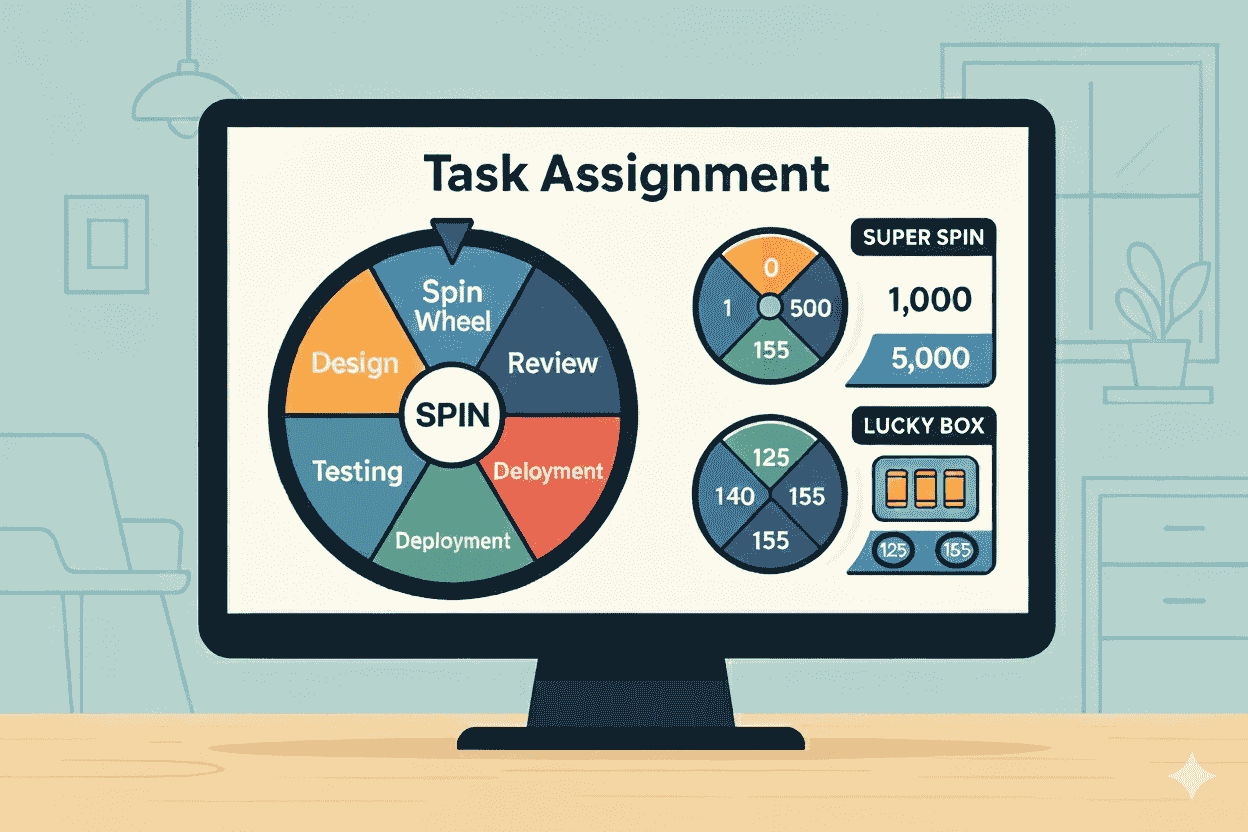
- Multiple spinner formats — choose between the Classic Wheel, Center Spin, or Lucky Box depending on your meeting format
- No login required to spin — low friction for quick use during live meetings
- Clean, distraction-free interface — screen-shares cleanly without cluttered UI or pop-ups interrupting the moment
For teams that run recurring meetings and want to make fairness a structural habit rather than a conscious effort, WheelSpinPro becomes a quiet but consistent piece of meeting infrastructure.
The Bottom Line: Fairness Is a Productivity Strategy
The connection between fairness and productivity isn't soft — it's structural. Teams that distribute work equitably develop more resilient skill sets. Teams that resolve decisions quickly protect meeting momentum. Teams that ensure every voice can be heard build higher engagement and idea diversity.
A spin wheel is a small, zero-cost intervention that supports all three. It doesn't transform a dysfunctional team into a high-performing one on its own — but it removes a category of friction that silently slows down even good teams, every single day.
Used correctly, it's not a novelty. It's a fairness habit with a measurable productivity return.
📎 Related Articles on WheelSpinPro
- Why Fair Decision-Making Matters — And How Randomization Fixes It — the psychology behind procedural fairness
- Spin Wheel Games for Classrooms and Online Learning — how educators apply the same principles
- Try the Classic Spin Wheel — build your team wheel in under a minute
- Decision Fatigue in Remote Teams — why distributed teams are especially vulnerable to slow decisions
- All WheelSpinPro Tools — explore all spinner formats for different team contexts
Frequently Asked Questions
📚 External References
- Perlow, L., Hadley, C. N., & Eun, E. (2017). Stop the Meeting Madness — Harvard Business Review. Research on how unproductive meetings drain organizational capacity. hbr.org
- Sunstein, C. R. & Hastie, R. (2014). Wiser: Getting Beyond Groupthink to Make Groups Smarter — Harvard Business Review Press. Foundational work on group polarization and decision-making inefficiency. Harvard Business School Publishing
- Detterman, D. K. & Sternberg, R. J. (1993). Transfer on Trial: Intelligence, Cognition, and Instruction — cited in research on participation equity and cold-call learning effectiveness in professional environments. APA PsycNet