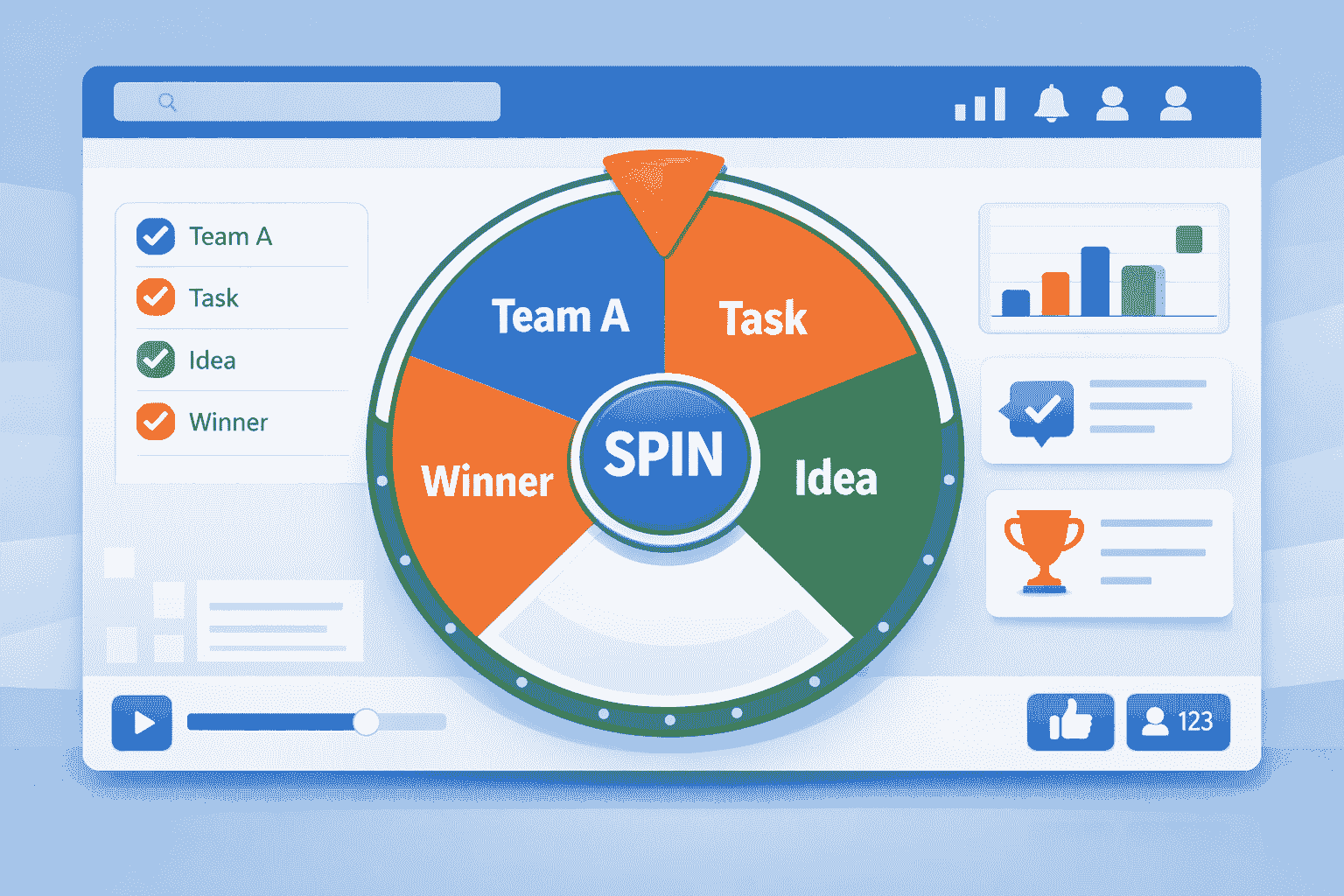
Why Fair Decision-Making Matters — And How Randomization Fixes It
Most decisions aren't hard because the options are bad. They're hard because bias, pressure, and fatigue cloud the process. Here's what the science says — and how structured randomization restores fairness.
Think about the last time a group tried to agree on something simple — where to eat, who presents next, which task gets tackled first. What should have been a five-second decision stretched into an uncomfortable negotiation, with someone inevitably walking away unsatisfied.
This isn't a people problem. It's a decision architecture problem. When humans make choices without a structured process, cognitive bias, social pressure, and mental exhaustion quietly corrupt the outcome. The result: slow decisions, perceived unfairness, and eroded trust.
Randomization — specifically, tools like spin wheels — addresses this at the root. Not because randomness is inherently smarter than judgment, but because it removes the human variables that make equal choices feel unequal.
This article breaks down the psychology of fair decision-making, when randomization is the right tool, and how to apply it effectively in real-world scenarios.
What Makes a Decision "Fair"?
Fairness in decision-making is not just about outcomes — it's about process legitimacy. Psychologists call this procedural fairness: the idea that people accept outcomes more readily when they trust the process that produced them, even if the outcome doesn't favor them personally.
According to research published in Organizational Behavior and Human Decision Processes, employees who perceive decision-making processes as fair report higher job satisfaction, greater organizational commitment, and lower turnover intent — regardless of whether their preferred outcome was chosen.
Three factors consistently undermine fair decisions in group settings:
- Authority bias — deferring to the loudest voice or highest-ranking person in the room
- Anchoring — disproportionate weight given to the first option mentioned
- Social pressure — conforming to perceived group consensus rather than genuine preference
Randomization neutralizes all three. When a spin wheel makes the call, no one's authority, speed of speaking, or social capital influences the result.
Decision Fatigue: The Hidden Tax on Productivity
Decision fatigue is a well-documented psychological phenomenon in which the quality of decisions deteriorates after a long session of decision-making. It was notably studied by researcher Roy Baumeister, whose ego depletion theory showed that willpower and rational decision-making draw from the same limited cognitive reservoir.
"The more decisions you make, the worse your mental resources become — and the more likely you are to either make impulsive choices or avoid decisions altogether."
— Baumeister et al., Ego Depletion: Is the Active Self a Limited Resource?
A landmark study of Israeli parole board judges found that prisoners who appeared before the board early in the morning received parole approximately 65% of the time. Those seen later in the day — after dozens of decisions had already been made — received parole at rates near 0%. The legal merits hadn't changed. The judges' cognitive capacity had.
When Decision Fatigue Hits Hardest
Decision fatigue is amplified in these contexts:
- Back-to-back team meetings with unresolved action items
- Classrooms where the teacher must constantly manage participation and order
- Households navigating daily logistics (meals, chores, entertainment)
- Remote teams distributed across time zones making asynchronous calls
In each of these scenarios, the decisions themselves may be low stakes — but the cumulative cognitive cost is not.
Why Randomization Is a Legitimate Decision-Making Strategy
Randomization is often dismissed as arbitrary. But this misunderstands its proper domain. Randomization is not a substitute for judgment — it is a conflict-resolution tool for situations where all options are acceptable.
Game theorists and economists recognize a class of decisions called symmetric decisions: scenarios where options are roughly equivalent in value and the primary goal is resolution, not optimization. In these cases, random selection is provably optimal — it guarantees equal probability for all parties and eliminates costly deliberation.
- All options are acceptable outcomes
- The cost of deliberation exceeds the value of optimization
- Perceived bias is causing friction in the group
- A recurring decision needs to rotate fairly over time (e.g., who leads stand-ups)
- You need a neutral tiebreaker after genuine deliberation
- Decisions with significant asymmetric risk (medical, legal, financial)
- When options have meaningfully different quality levels
- When individual preferences carry ethical or safety weight
- When accountability for the decision matters (leadership choices, hiring)
Understanding this boundary is what separates effective use of randomization from misuse. A spin wheel should never replace critical thinking — it should eliminate unnecessary friction where critical thinking isn't needed.
Real-World Use Cases for Spin Wheel Decision-Making
Below are the most common environments where random spin wheels deliver measurable fairness and efficiency gains:
How Online Spin Wheels Enforce Fairness Mechanically
A well-built spin wheel randomizes outcomes using a pseudo-random number generator (PRNG), which selects a stopping point from a statistically uniform distribution. This means every segment on the wheel has an equal probability of landing, regardless of its visual position or the order it was added.
This is not trivially obvious to users — which is part of why the visual format builds trust. Unlike a spreadsheet function that quietly returns a number, a spinning wheel performs the randomness in public. Everyone watching sees the same unpredictable event unfold.
Psychological Benefits of Visual Randomization
- Perceived neutrality — the visual spectacle signals "no human made this call"
- Acceptance of outcome — losers are less likely to protest when they watched the process
- Reduced cognitive load — the decision-maker is freed from justifying a choice
- Engagement boost — the animated spin creates momentary excitement, especially in group settings
How to Use a Spin Wheel for Fair Decision-Making: Step-by-Step
Before spinning, confirm that all options on the wheel are genuinely acceptable. A spin wheel doesn't evaluate quality — it just picks. Make sure you've already filtered out unacceptable options.
Add every qualifying option to the wheel. Omitting options undermines the fairness you're trying to achieve. If some options should be weighted, check whether your tool supports probability weighting.
Agree before spinning that the result is final. Allowing re-spins when someone dislikes the outcome defeats the entire purpose. This commitment is what makes the process legitimate.
The transparency of the process is what makes it trusted. Screen share it, project it, or gather around a device. Public visibility eliminates any suspicion of manipulation.
For recurring decisions (like task rotation), log what was selected each time. This creates a historical record that ensures long-term fairness across multiple spins.
Spin Wheel vs. Other Decision Methods: A Comparison
| Method | Speed | Bias Risk | Perceived Fairness | Best For |
|---|---|---|---|---|
| Group Vote | Slow | High (social pressure) | Medium | High-stakes group alignment |
| Manager Decides | Fast | Very High | Low | Urgent, single-accountability decisions |
| Coin Flip | Very Fast | None | High (binary only) | Two-option tiebreakers |
| Random Number Generator | Fast | None | Medium (opaque process) | Technical/backend use |
| Spin Wheel | Very Fast | None | Very High (visible + engaging) | Multi-option, group settings |
The spin wheel's advantage over a plain random number generator is the visible, participatory nature of the process. This social dimension is what builds trust — and trust is what makes group decisions stick.
Common Mistakes When Using Spin Wheels for Decisions
- Using it as a way to avoid responsibility for bad options. If one of the options on the wheel is genuinely unacceptable, don't spin — remove it first.
- Allowing re-spins when the result is inconvenient. This destroys trust and teaches participants that the wheel is just theater. Commit in advance.
- Overusing it for decisions that require judgment. Randomness is for symmetrical choices. Using it to assign complex projects with asymmetric skill requirements is a misuse.
- Not updating the wheel over time. In recurring decisions (task rotation), remove names that have already "won" to ensure true rotation fairness.
- Spinning privately and announcing results. The transparency of the spin is its legitimacy. Always spin in front of those affected.
Using WheelSpinPro for Fair, Structured Randomization
WheelSpinPro is designed specifically for decision-making contexts that require both fairness and engagement. Unlike basic random pickers, it offers multiple spinner formats suited to different needs:
- Classic Wheel — the standard multi-option spinner for group decisions
- Center Spin — ideal for classroom environments with a central, visible display
- Lucky Box — a grid-based picker suited for prize draws and gamified choices
- Coin Toss & Dice Roll — for binary or numbered randomization without a wheel format
All variants support custom entries, result history tracking, and sound/visual feedback — practical features that matter when you're using the tool in a live group setting and need the result to feel final and legitimate.
Final Takeaway: Fairness Is a System, Not a Feeling
The reason most group decisions feel unfair isn't malice — it's the absence of a structured, neutral process. Human brains are pattern-matching machines that default to authority gradients, social norms, and cognitive shortcuts whenever the stakes feel low. This produces decisions that look reasonable but carry hidden bias.
Randomization, used correctly, is a legitimate and psychologically robust response to this problem. It doesn't replace human judgment — it applies it precisely where judgment adds value, and steps aside everywhere else.
A well-designed spin wheel is not a toy. It's a fairness infrastructure — a small but meaningful system for preserving trust, reducing friction, and keeping groups moving without the baggage of politics or fatigue.
For low-stakes, symmetrical choices, spinning is often the most rational thing you can do.
📎 Related Articles on WheelSpinPro
- How Random Spin Wheels Improve Team Productivity — deeper look at workplace applications
- Spin Wheel Ideas for the Classroom — teacher-specific use cases and engagement strategies
- Try the Classic Spin Wheel — start making fair decisions instantly
- Decision Fatigue in Remote Teams — why distributed teams are especially vulnerable
- Lucky Box Picker — for prize draws and gamified group activities
Frequently Asked Questions
📚 External References
- Baumeister, R. F., et al. (1998). Ego Depletion: Is the Active Self a Limited Resource? — Journal of Personality and Social Psychology. APA PsycNet
- Danziger, S., Levav, J., & Avnaim-Pesso, L. (2011). Extraneous factors in judicial decisions — Proceedings of the National Academy of Sciences. PNAS.org
- Colquitt, J. A. (2001). On the dimensionality of organizational justice — Journal of Applied Psychology (foundational work on procedural fairness). APA PsycNet