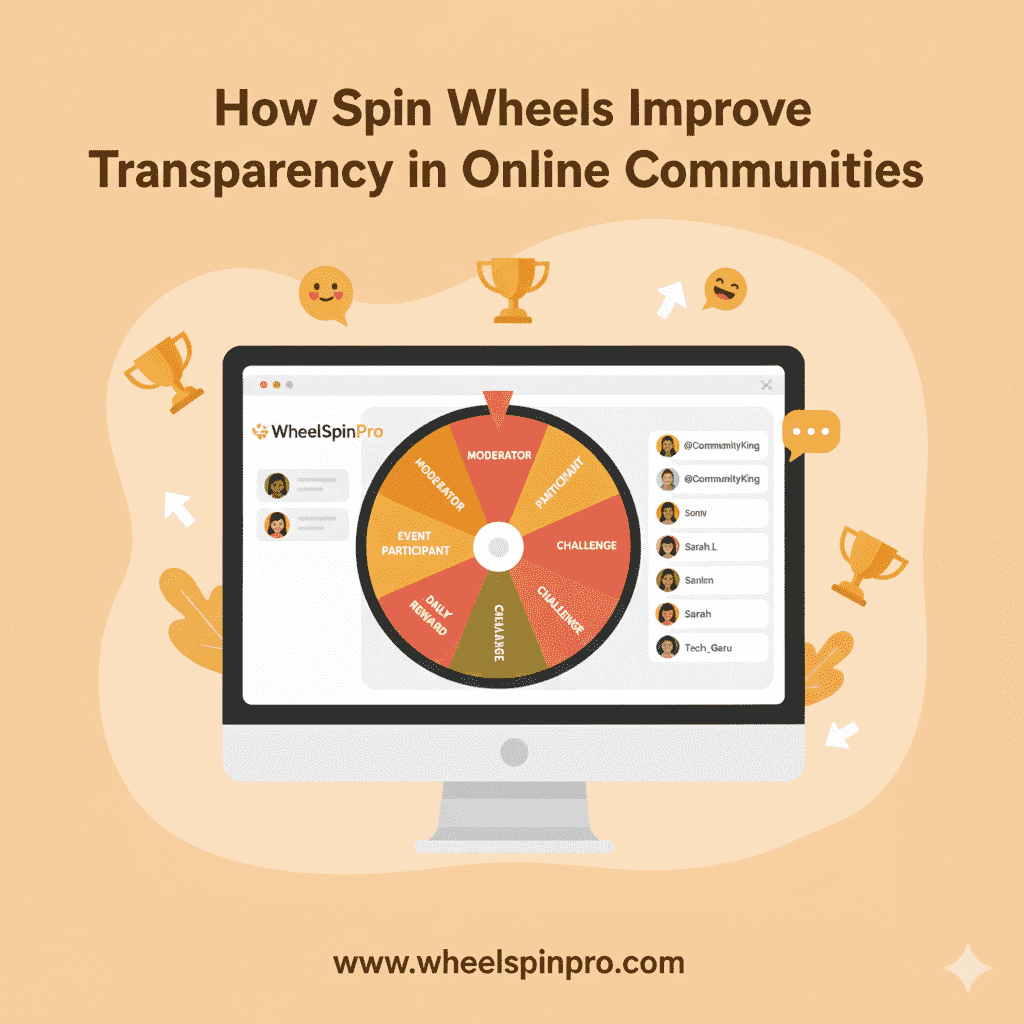
How Spin Wheels Improve Transparency in Online Communities — And Why It Matters More Than Most Admins Realize
Online communities don't collapse because of bad content or low activity. They collapse because trust erodes — and trust erodes fastest when members believe decisions are being made unfairly behind closed doors. A spin wheel doesn't just pick a winner. It makes the selection process visible to everyone watching.
Managing an online community is fundamentally a trust management problem. Whether it's a Discord server with 500 members, a Reddit community with 50,000 subscribers, a Facebook group, or a Twitch channel with a regular viewer base — the long-term health of any online community depends on members believing that they are treated fairly and that the community is governed by consistent, transparent principles.
When that belief breaks down — when a giveaway winner seems suspiciously close to the admin, when a moderator role goes to someone without visible explanation, when the same members keep winning community rewards — the damage is rarely limited to the single disputed decision. It cascades. Vocal members raise the issue publicly. Others amplify it. The admin's credibility is questioned. Engagement drops. Some members leave.
This pattern is so consistent across online communities of every size and platform that researchers who study digital communities have a name for it: perceived procedural injustice — the belief that a community's decision-making processes are not neutral, regardless of whether they actually are.
A spin wheel addresses the root of this problem — not by making better decisions, but by making the decision process visible. This article explains why that visibility matters, where it is most valuable in community management, and how to implement it effectively across different community types and platforms.
Why Transparency Is a Structural Requirement for Online Community Trust
In physical communities — a neighborhood, a workplace, a club — trust is built through repeated in-person interaction, shared context, and the social accountability that comes from physical proximity. Members can observe each other's behavior directly over time and form calibrated judgments about who is fair, who is reliable, and who has good intentions.
Online communities have none of these mechanisms. Members typically know each other only through usernames, text interactions, and the digital artifacts of shared activity. The social accountability of physical presence is absent. Trust must be built and maintained through a different set of signals — and the most important of those signals is procedural consistency.
Research on online community behavior consistently identifies perceived procedural fairness as a primary determinant of member retention, contribution quality, and willingness to defend the community against conflict. When members believe the rules are applied consistently and decisions are made through visible, neutral processes, they invest more deeply in the community. When they don't, they disengage — or worse, actively destabilize.
The Asymmetry of Trust and Suspicion
Trust in online communities is not symmetrically distributed. A community can operate with healthy trust for months and lose it through a single high-profile perceived injustice — a giveaway winner who seems to know the host, a moderation decision that appears to have personal motivation, a reward that never reaches its announced recipient. Rebuilding that trust after it's lost is significantly harder than maintaining it through proactive transparency measures.
This asymmetry means that preventing trust damage is exponentially more valuable than repairing it. A spin wheel, used consistently for community decisions, is a preventive infrastructure investment — not a reactive response to an existing problem.
Where Opaque Decision-Making Causes the Most Community Damage
Not all community decisions carry equal trust risk. Some decisions are low-stakes enough that members accept admin judgment without question; others are high-visibility enough that any appearance of unfairness immediately becomes a community incident. Understanding which decisions fall into which category is the first step in deploying transparency tools effectively.
| Decision Type | Trust Risk Level | Why It Creates Conflict | Transparency Tool Needed? |
|---|---|---|---|
| Giveaway & prize winner selection | 🔴 Very High | Every non-winner is a potential skeptic; monetary value heightens scrutiny | ✅ Essential |
| Moderator & role assignment | 🔴 Very High | Power allocation; any appearance of favoritism delegitimizes the role and the admin | ✅ Essential |
| Featured member or spotlight selection | 🟠 High | Visibility rewards; excluded members question why they weren't chosen | ✅ Recommended |
| Challenge & contest winner selection | 🟠 High | Competitive context amplifies fairness expectations; losers scrutinize the process | ✅ Recommended |
| Event scheduling & topic selection | 🟡 Medium | Members with different preferences feel unheard; perception of admin self-interest | ⚡ Beneficial |
| Content feature decisions | 🟡 Medium | Creators whose work isn't featured may feel overlooked | ⚡ Beneficial |
| Routine moderation actions | 🟢 Lower | Rule violations have clear documentation; less susceptible to fairness accusations | ➖ Less critical |
The pattern is clear: any decision where members were eligible to receive a benefit and didn't carries high trust risk. These are exactly the decisions where a visible, verifiable spin wheel process produces the highest trust-protection return.
How Spin Wheels Create Verifiable Transparency — Not Just Claimed Fairness
The critical distinction in community transparency is between claimed fairness ("we selected the winner fairly") and verifiable fairness ("we selected the winner through a process you watched happen in real time"). Online communities are deeply skeptical of claimed fairness — because claims require trust the community may not yet have extended. Verifiable fairness requires no pre-existing trust; it demonstrates the process rather than asserting it.
A spin wheel creates verifiable fairness through three mechanisms:
1. Visible Input
When all eligible names or entries are loaded onto the wheel before a live stream, screen share, or recorded video, members can confirm they are included in the draw. This verification step — "I can see my name on the wheel" — is foundational. A winner selected from a wheel whose inputs members couldn't verify is only marginally more trustworthy than a private selection.
2. Witnessed Process
The spin happens in front of the community — live, on screen, in real time. Everyone watching sees the same unpredictable event unfold simultaneously. There is no gap between when the decision is made and when it is announced; the decision is made publicly, in the moment of the spin. This simultaneous witnessing is what makes the outcome genuinely verifiable rather than simply reported.
3. Non-Human Selection
The outcome was determined by an algorithm, not by a person. This removes every possible personal motivation from the selection process: no favoritism, no relationships, no personal stakes, no bias that members can construct a narrative around. "The wheel chose" is a categorically different statement from "I chose" — even if the person who set up the wheel could theoretically have manipulated it, the public visibility of the spin makes any such manipulation immediately apparent.
- Visible inputs — members can confirm their eligibility and see the full entry pool before the spin
- Witnessed process — the spin happens live, on screen, with the community present
- Non-human selection — the outcome is produced by a visible random mechanism, removing personal agency from the result
Community Use Cases: How Different Communities Apply Spin Wheels
Discord Servers
Discord is among the highest-risk environments for perceived unfairness — its structure of roles, permissions, and admin hierarchy makes power asymmetry visible, and the close proximity of members in active servers means any fairness incident spreads instantly through shared channels. Spin wheels are used in Discord communities for:
- Live giveaway draws — server booster rewards, subscriber milestones, holiday giveaways — spin during a live session with the server's voice or video channel active so members witness it in real time
- Role assignment for limited roles — when more members want a special role than there are slots available, a spin draw is more defensible than admin selection and significantly reduces post-announcement complaints
- Game night host selection — who picks the game, who hosts the session, who sets the rules — recurring decisions where perceived fairness determines whether members show up
- Featured member rotation — a wheel ensures everyone with qualifying contributions gets visibility over time, not just those who are most visible to the admin already
Twitch and YouTube Live Streams
Live streaming communities have a built-in transparency advantage: the stream itself is the verification context. A spin wheel spun during a live stream is witnessed by every viewer simultaneously — there is no more verifiable selection process in online community management. Applications include:
- Subscriber giveaways — load subscriber names, spin live, announce the winner in the same moment the wheel stops. The chat reaction to seeing a community member's name on the wheel adds an engagement dimension that static announcements cannot replicate.
- Viewer challenge selection — which viewer gets to challenge the streamer, which viewer's submitted idea gets played, which viewer question gets answered on stream
- Donation or bit goal reward draws — spin to select which supporter receives a reward when a milestone is reached, creating a fair selection from eligible contributors
- Community game selection — when the audience votes for multiple games and produces a tie or indecisive result, a spin breaks it transparently on stream
Reddit Communities and Subreddits
Reddit's upvote/downvote structure creates its own fairness perceptions — but for decisions that go beyond post visibility, moderators face the same transparency challenges as any other community admin. Spin wheel applications in Reddit communities include:
- Moderator recruitment from applicant pools — when multiple qualified candidates apply, a spin (after eligibility filtering) is more defensible than a private moderator vote and avoids the appearance of insider selection
- Reddit giveaway post winner selection — recording and sharing the spin draw as proof of fair selection, posted in the comments of the giveaway thread
- Community event host rotation — who runs the weekly thread, who moderates the AMA, who leads the community challenge
Facebook Groups and Private Communities
Facebook groups often have older, less tech-savvy member bases who are highly sensitive to perceived favoritism — particularly in buy/sell groups, hobby communities, and local interest groups where transactions and shared resources are at stake. Spin wheels in these contexts:
- First-come-to-spin buy rights — for high-demand group sales where multiple members want the same item, a live spin on a group video call determines fair claim order
- Group admin selection from nominees — when a group needs new admins, a public nomination and spin process is more defensible than private selection
- Event seat allocation — when event capacity is limited and demand exceeds supply, a spin draw is fairer and more transparent than a first-come-first-served system that disadvantages members in different time zones
How Transparent Processes Reduce Community Conflict: The Mechanism
Conflict in online communities rarely starts with the decision itself. It starts with the absence of a visible process. When a winner is announced without explanation of how they were selected, members fill the information gap with inference — and inference defaults to suspicion when trust is not well-established.
This is not unique to online communities. Organizational psychology research on procedural justice (Colquitt, 2001) consistently shows that the perceived fairness of a decision-making process affects satisfaction with the outcome more strongly than the outcome itself. Members who receive an unfavorable outcome from a visibly fair process accept it at higher rates than members who receive a favorable outcome from an opaque process — because the process generates trust that the outcome cannot.
The Conflict Prevention Mechanism
A spin wheel prevents conflict through three specific pathways:
- Pre-emptive verification — when members see their name or entry on the wheel before the spin, they have confirmed their own eligibility. Post-result claims of "I wasn't included" are eliminated when the input was publicly visible.
- No agent to accuse — conflict typically targets a person: the admin who made the call, the moderator who benefited, the member who seems favored. A spin wheel removes the human agent from the selection, eliminating the target. Conflict cannot attach to an algorithm.
- Shared witnessing creates social closure — when an entire community watches a spin happen simultaneously, the result has social legitimacy that no amount of after-the-fact explanation can replicate. Community members become witnesses rather than skeptics — and witnesses are natural defenders of the outcome they watched occur.
How to Run a Transparent Spin Wheel Selection in Your Community
Before collecting entries or preparing the wheel, publish the eligibility rules clearly in the community: who qualifies, what the qualifying action is (subscribe, comment, react, attend), and what the deadline is. Eligibility disputes are the primary source of post-result conflict — public criteria established in advance eliminate most of them.
Filter the entry pool against your eligibility criteria before adding names to the wheel. Discovering an ineligible entry after a public spin creates a worse trust problem than the one you were trying to prevent. Do the verification work privately, then present a clean, verified wheel to the community.
Add names to the wheel on screen — in a live stream, a screen-shared video call, or a recorded session. Let members watch themselves and others being added. This step converts passive audience members into invested witnesses before the spin even begins.
State clearly and visibly that the entry pool is now final and no further names will be added. This single announcement prevents the most common post-result complaint: "you added extra people after you knew who would win." It sounds obvious; it is routinely skipped and routinely regretted.
Spin in front of the community. Commit publicly to the first result being final. Re-spins — for any reason other than a genuine technical failure that the community can clearly observe — destroy the legitimacy of the entire process. If you need to address an eligibility issue after the spin, do so transparently and conduct a second spin from the remaining pool, with the community watching.
Save or clip the spin recording and post it as a permanent record in the community — pinned in the Discord channel, linked in the Reddit post, shared as a group post. Members who weren't present can verify the process retroactively. This archive is also your protection against future revisionism about how the decision was made.
Announce the winner in the community channel where the draw was conducted before any private contact. Set a public claim window (24–48 hours is standard). State publicly what happens if the prize is unclaimed — typically a re-spin from the same recorded session. This closes the loop for the community and prevents the "did the winner actually get it?" questions that prolong engagement around the result.
Community Transparency Mistakes That Undermine Trust Even With a Spin Wheel
A spin wheel used incorrectly can actually damage trust more than a private selection — because it creates the appearance of transparency while undermining it. These are the most common mistakes:
- Spinning privately, then announcing the result — a privately spun result carries no more legitimacy than a private selection. The witnessing is what creates the trust, not the spinning.
- Loading entries that haven't been verified publicly — if members can't confirm the entry pool before the spin, they can't verify their own inclusion, and post-result doubt persists.
- Re-spinning without explicit justification — even if a re-spin is technically warranted, doing it without clear public explanation looks like you didn't like the first result. Explain before spinning again.
- Using the spin only when it's convenient — communities notice when admins use spins for some decisions and opaque processes for others. Inconsistency signals that transparency is selective rather than principled.
- Failing to archive the spin — without a permanent record, late-arriving skeptics have no way to verify the process. The archive is as important as the live spin.
- Announcing eligibility criteria after the spin — determining eligibility retroactively (especially when the result produces complaints) is among the most damaging transparency failures an admin can make.
Building a Long-Term Transparency Culture in Your Community
A single transparent spin wheel draw produces a localized trust benefit. A consistent, systematic commitment to transparent processes produces a community culture — a shared expectation that decisions are made fairly, which becomes self-reinforcing over time.
Communities with established transparency cultures are measurably more resilient to conflict than those without. When a community has a documented history of transparent processes, individual members are less likely to raise fairness challenges — because the baseline expectation is fairness, and the community itself has social norms around defending that baseline.
Practical Steps for Building Transparency Culture
- Create a community document that describes how decisions are made — a pinned post or server guide that explains which decisions use spin wheels, which use votes, and which are at admin discretion. Transparency about the transparency framework is itself trust-building.
- Use spin wheels consistently, not only when convenient — apply the same transparent process to decisions that are likely to produce popular outcomes as to those that might produce complaints. Selective transparency is perceived as manipulative.
- Acknowledge when you can't use a spin wheel and explain why — some decisions genuinely require admin judgment (moderation calls, urgent decisions, decisions requiring context members don't have). Acknowledging this explicitly — "we're handling this as an admin judgment call because..." — is more trustworthy than applying a transparency process that doesn't fit the decision.
- Invite community input on transparency practices — asking members how they want decisions to be made, and genuinely incorporating their feedback, is itself a transparency practice that builds ownership and reduces adversarial dynamics.
Using WheelSpinPro for Community Transparency
WheelSpinPro provides the specific features that make community transparency practical across different platforms and community sizes:
- Clean, high-contrast visual — renders clearly on screen shares, stream overlays, and recorded videos across all platforms without quality loss or visual clutter competing for member attention
- Pre-built saveable wheels — create standing wheels for recurring community decisions (monthly giveaway draw, weekly challenge winner, featured member rotation) and access them instantly without re-entering data each time
- Results history tracking — log every spin outcome as a built-in audit trail; essential for communities that run recurring draws and need to demonstrate consistent, fair rotation over time
- Multiple spinner formats — Classic Wheel for standard name draws, Lucky Box for prize reveal formats, Center Spin for large-screen live event display
- No account required for the audience — community members don't need accounts to watch or verify; the admin operates the tool and members observe without friction
- Browser-based, works on any device — share to any platform via screen share without compatibility issues or software requirements
For the broader context of how spin wheels build trust in public giveaway contexts, see our guide on fair giveaways and contests using online spin wheels.
Final Thoughts: Transparency Is Community Infrastructure
Online communities are not fragile by nature. They are fragile when their governance is opaque — when members cannot verify that decisions affecting them are made fairly, and when disputes about fairness have no objective process to appeal to.
A spin wheel is governance infrastructure. It doesn't replace admin judgment for decisions that require it. It fills the gap for decisions where visible, neutral, random selection is both appropriate and more trustworthy than any human choice could be — simply because it removes the human from the equation in a way that the entire community can observe.
Used consistently, it doesn't just prevent individual disputes. It builds the cumulative procedural trust that makes a community resilient: a shared understanding among members that this community is governed fairly, demonstrated repeatedly over time through visible process rather than asserted through claimed intention.
That trust is the most durable form of community health. And it is built one transparent spin at a time.
📎 Related Articles on WheelSpinPro
- Fair Giveaways and Contests Using Online Spin Wheels — prize draw transparency and brand trust mechanics for public promotions
- Why Fair Decision-Making Matters — And How Randomization Fixes It — the psychology of procedural fairness and outcome acceptance
- Spin Wheels vs. Manual Decision Making — why visible random selection outperforms human judgment for neutral selections
- Using Spin Wheels for Events and Team Building — live event transparency and engagement applications
- Try the Classic Spin Wheel — build your community draw wheel in under a minute
Frequently Asked Questions
📚 External References
- Colquitt, J. A. (2001). On the Dimensionality of Organizational Justice: A Construct Validation of a Measure — Journal of Applied Psychology, 86(3). Foundational research establishing that procedural fairness (the perceived fairness of the process) affects satisfaction and acceptance as strongly as distributional fairness (the outcome itself). APA PsycNet
- Ren, Y., Kraut, R., & Kiesler, S. (2007). Applying Common Identity and Bond Theory to Design of Online Communities — Organization Studies, 28(3). Research on the structural determinants of online community health and member retention, including the role of perceived procedural fairness in sustaining engagement. SAGE Journals
- Preece, J. (2001). Sociability and Usability in Online Communities: Determining and Measuring Success — Behaviour & Information Technology, 20(5). Framework for evaluating online community health, including trust, participation, and governance transparency as core sociability requirements. Taylor & Francis Online
Written by the Wheel Spin Pro Team
The developers behind Wheel Spin Pro's spin engines and 130+ unique pickers. We write practical guides on fair random selection for classrooms, giveaways, and events. More about us.