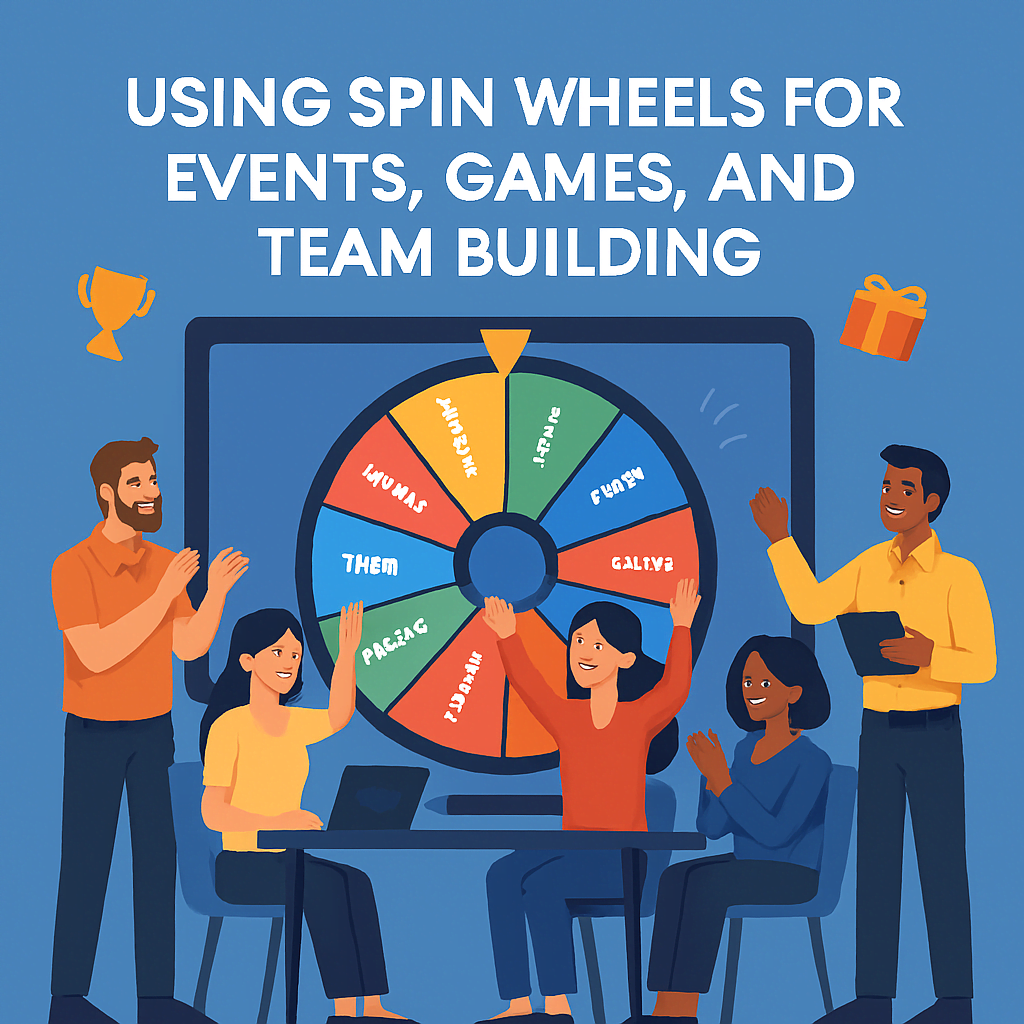
Using Spin Wheels for Events and Team Building: The Organizer's Complete Guide
The difference between an event people remember and one they endure is usually a single word: participation. Spin wheels are one of the most reliable tools for converting passive audiences into active ones — and the mechanics behind why they work apply equally to corporate conferences, classroom workshops, virtual team sessions, and casual parties.
Event engagement is harder to sustain than it looks from the outside. Even well-designed programs lose momentum during transitions, struggle to activate quieter participants, and fail to create the shared energy that makes an event feel genuinely cohesive rather than just scheduled.
The instinct is to solve this with more content — a better speaker, a slicker presentation, a higher-budget production. But research on audience engagement consistently points in a different direction: what people remember about events is not what they watched, but what they did.
Interactive moments — where attendees are participants rather than audience members — produce stronger emotional memory, higher reported satisfaction, and greater likelihood of return attendance. The challenge is creating these moments without the friction of complex game setups, uncomfortable forced participation, or activities that feel disconnected from the event's purpose.
A spin wheel is a structurally simple solution to a structurally complex problem. It creates shared interactive moments on demand, with zero setup friction, in formats that scale from a five-person team workshop to a five-hundred-person conference. This guide explains how — and exactly when — to use it.
Why Passive Events Fail: The Psychology of Audience Engagement
The distinction between watching and doing is not a preference — it is a neurological difference in how experiences are encoded and retained. Research on experiential learning, most formally articulated in Kolb's Experiential Learning Cycle, establishes that active participation produces significantly stronger learning and memory formation than passive observation.
In event contexts, this translates directly: attendees who do something at an event — answer a question, compete in a challenge, win or lose a draw — remember the event more vividly, associate it with stronger positive emotion, and are more likely to discuss it afterward than those who watched the same content passively.
The spin wheel's specific psychological mechanism is anticipation plus shared uncertainty. Everyone in the room is watching the same unpredictable event unfold at the same time — which creates the conditions for collective emotional experience. This is the same mechanism behind sports viewing, game shows, and lottery draws. It doesn't require high stakes to be effective; it requires genuine unpredictability and a shared stake in the outcome.
Why Forced Participation Backfires
Event organizers sometimes respond to engagement problems with mandatory participation mechanics — requiring audience members to speak, perform, or interact on command. This reliably produces the opposite of engagement: anxiety, resistance, and the specific discomfort of being compelled to do something in front of strangers without warning.
The spin wheel sidesteps this entirely. Being selected by a wheel is socially and psychologically different from being called out by a person. The selection is non-judgmental, visibly neutral, and shared with an audience that is also waiting to see what happens. Participants accept the call-to-action because the wheel chose them, not because a facilitator decided to single them out.
Which Events Benefit Most From Spin Wheel Integration
Spin wheels are not one-size-fits-all event tools — their value depends on the type of interaction an event needs. Here is how they map to the most common event formats:
| Event Type | Primary Challenge | Spin Wheel Application | Impact |
|---|---|---|---|
| Corporate conferences | Passive audiences, energy drops between sessions | Audience participation draws, Q&A selector, prize draws | Reactivates attention at key moments |
| Team workshops | Uneven participation, dominant voices | Random speaker selection, group formation, topic assignment | Equalizes contribution across participants |
| Virtual meetings & webinars | Camera-off disengagement, no social cues | Screen-shared name wheel, interactive polls, challenge spins | Creates shared attention moment in passive format |
| Brand activations | Low dwell time, weak memorability | Spin-to-win discounts, prize tier reveals, lead capture spins | Extends time-on-site and increases conversion |
| Parties & social events | Social awkwardness, slow warm-up | Icebreaker prompts, game selection, challenge wheel | Accelerates social bonding without pressure |
| Training sessions | Passive learning, low retention | Random participant selection, scenario assignment, quiz randomizer | Forces active engagement with material |
Spin Wheels for Team Building: Beyond the Icebreaker
Team building activities have a reputation problem. Many employees approach them with resigned tolerance rather than genuine enthusiasm — because the activities feel manufactured, the forced vulnerability is uncomfortable, and the "fun" is obligatory. The result is an activity that technically happened but produced none of the social cohesion it was designed to create.
The core failure of most team building activities is not the activity itself — it's the social dynamics around how participation is structured. When people are voluntarily self-selected into activities, existing social hierarchies reproduce themselves: outgoing people lead, quieter people watch, and the experience reinforces rather than disrupts existing group patterns.
A spin wheel disrupts these patterns structurally, without confrontation. When a wheel determines who speaks next, which team someone joins, or what challenge a group must complete, the social hierarchy is temporarily suspended. The wheel chose — and everyone accepted it the same way.
High-Impact Team Building Applications
The Science Behind Why Random Grouping Works
Research on social network diversity in organizations consistently shows that cross-functional, cross-seniority relationships are the strongest predictor of organizational resilience and innovation output — yet most employees report that their meaningful workplace relationships are limited to their immediate team. Team building events are designed to address this, but self-selection undermines the goal.
Random grouping via spin wheel is one of the simplest structural interventions for creating cross-boundary connections in a single session. The randomness is not arbitrary — it is the mechanism that forces the exact outcome the event was designed to produce.
Spin Wheel Icebreakers That Actually Work: Design Principles and Examples
Most icebreakers fail for one of two reasons: they are too intimate (requiring personal disclosure that feels inappropriate with near-strangers), or they are too trivial (producing polite participation but no genuine connection). A spin wheel doesn't fix a badly designed icebreaker — but it substantially improves a well-designed one by removing the social friction around who goes first, who chooses the question, and who gets to pick the easier prompt.
Icebreaker Wheel Design Principles
- Calibrate to the relationship level. A team that has worked together for years can handle deeper prompts than strangers at a conference opening session. Match the intimacy of the question to the existing social familiarity of the group.
- Use open-ended prompts, not yes/no questions. "What's a skill you have that surprises people?" produces more connection than "Do you prefer coffee or tea?"
- Include a mix of personal and professional. A wheel with purely professional prompts feels like a meeting. A wheel with purely personal prompts can feel invasive. The best icebreaker wheels alternate between both registers.
- Keep prompts short and immediately answerable. Prompts that require extensive thought slow down the session and increase anxiety for participants who haven't been selected yet.
Example Prompt Sets by Event Type
| Event Type | Example Icebreaker Prompts for the Wheel |
|---|---|
| Corporate onboarding | "One skill from a previous role that surprises people" · "Best piece of work advice you've received" · "Something you're working on outside of work" |
| Team workshop | "What would your teammates be surprised to learn about you?" · "A project you're most proud of" · "Your go-to problem-solving approach" |
| Conference session opener | "Why you chose your field" · "Most unexpected career pivot" · "One thing you want to leave this event knowing" |
| Social or party | "Most underrated travel destination you've been to" · "A talent no one at this event knows you have" · "Best meal you've ever eaten" |
Spin Wheels for Virtual Events: Solving the Engagement Collapse Problem
Virtual events suffer from a specific engagement pattern that in-person events do not: a rapid post-opening collapse in active participation. The first ten minutes of a webinar typically show high attendance and some chat activity. By thirty minutes in, cameras are off, attention has fragmented, and the event has functionally become background noise for multitasking.
This is not a motivation problem. It is a structural one. Virtual attendees have no social accountability — no one can see them disengaging — and no interruption cost for switching their attention elsewhere. The only countermeasure is creating genuine interactive moments that pull attention back to the session and make disengagement feel like a real miss.
Virtual Event Spin Wheel Applications
Open the virtual session by loading all attendee names into a visible wheel and spinning to select who answers the first question or shares a brief intro. This signals immediately that attendance is participatory, not observational — and it creates the anticipation effect before a single slide has been shown.
Plan deliberate spin moments at 20–25 minute intervals — the point at which virtual attention typically begins to fragment. A spin to select who answers a discussion question, or which topic the group addresses next, forces attention back to the session with a low-effort, high-impact interactive moment.
For sessions with breakout rooms, spin to assign participants to groups rather than allowing self-selection or manual assignment. Screen-share the spin so everyone sees the groups being formed. This prevents the clustering that reduces the value of breakout sessions and creates conversation across unfamiliar participants.
End the session with a spin-based prize draw or peer recognition moment. This gives attendees a reason to stay present through the conclusion rather than dropping off early — and it creates the emotional high note that becomes the last memory of the event.
Spin Wheels at Brand Activations and Live Events
For brand activations — trade shows, product launches, pop-up events, retail experiences — the challenge is dwell time and conversion. Most visitors spend thirty to ninety seconds at a brand stand before moving on. The brands that convert visitors to leads, contest entrants, or customers are those that create an interactive reason to stay longer.
A physical or projected spin wheel activation achieves this through three mechanisms:
- Permission to participate. The wheel gives visitors a concrete action to take, lowering the social barrier of approaching a branded stand and initiating engagement.
- Extended dwell time. Anticipation holds attention. A visitor waiting to see where the wheel lands stays at the stand longer than one who was simply handed a leaflet.
- Social proof generation. A visible, active spin wheel at a crowded event draws additional visitors — people stop to watch others spin, which creates a queue effect that signals desirability.
Brand Activation Spin Wheel Formats
- Spin-to-win discount or offer — visitors spin to reveal which discount tier they receive, making the offer feel earned rather than universal
- Prize draw entry — visitors enter their details for a chance to spin in a larger draw conducted at the end of the event
- Product selector — spin to determine which product sample or demo the visitor experiences, introducing variety and conversation
- Challenge wheel — visitors complete a branded challenge determined by the spin, sharing results on social media for additional reach
Planning Your Event Spin Wheel: What to Prepare Before You Arrive
The most common error event organizers make with spin wheels is treating them as improvisational tools — something to pull out when energy drops. A spin wheel used reactively works; a spin wheel integrated deliberately into the event flow works significantly better.
Every event has predictable low-energy moments: after the opening, post-lunch, during long presentation segments, before closing remarks. Identify these in your run-of-show and plan spin wheel moments specifically for each one. Reactive use fixes a problem; proactive use prevents it.
Create separate pre-built wheels for each application: one with attendee names for participation draws, one with icebreaker prompts, one with challenge activities, one for the prize draw. Load and test each before the event opens. Fumbling with wheel setup during a live session kills momentum instantly.
A spin wheel that looks perfect on a laptop screen may appear washed out on a projector or pixelated on a large LED display. Test the visual output on the equipment you will use at the event. Check font size, color contrast, and spin animation performance under event lighting conditions.
At larger events, the facilitator running the session should not also be managing the spin wheel device. Designate a technical operator who manages the wheel — adding entries, confirming the setup, and triggering the spin on cue — so the facilitator can focus on the room.
If your audience has not used a spin wheel before, spend fifteen seconds explaining the format: what's on the wheel, what happens when it lands, and what the selected person does. This removes uncertainty — the main source of reluctance in interactive activities — and sets clear expectations before the first spin.
Why Event Organizers Choose WheelSpinPro
WheelSpinPro is built for the operational realities of live events — where setup time is scarce, technical failures are costly, and the tool needs to work the first time in front of an audience.
- No download or installation — browser-based and accessible from any device immediately; no IT approval or software setup required before an event
- Pre-built saveable wheels — build your name wheel, prompt wheel, and prize wheel in advance; access them instantly during the event without re-entering data
- Multiple spinner formats for different contexts — Classic Wheel for standard draws, Center Spin for large-screen display at live events, Lucky Box for prize reveal formats
- Results history tracking — log all spin outcomes across a multi-session event; remove previous selections to ensure fair rotation throughout the day
- Clean, high-contrast visual — renders clearly on projectors, LED screens, and shared virtual screens without compression artifacts
- Works on tablets and touchscreens — ideal for brand activation stands where visitors spin themselves
The Bottom Line: Interaction Is the Event
Event organizers spend the majority of their budget and planning time on content — the speakers, the agenda, the production quality. But post-event research on memory and satisfaction consistently shows that what attendees remember is not the content they consumed, but the moments they participated in.
A spin wheel is one of the highest return-on-effort interactive tools available to any event organizer. It requires no budget, no lengthy setup, no trained facilitators, and no complex rules. It produces genuine shared excitement, equitable participation, and memorable moments — at the exact moments in your event program where energy would otherwise fade.
Used deliberately, at the right moments, with the right content loaded in advance, it doesn't just improve your event. It creates the kind of shared experience that people actually talk about afterward — and that is the entire point.
📎 Related Articles on WheelSpinPro
- Fair Giveaways and Contests Using Online Spin Wheels — how to run transparent prize draws that build audience trust
- How Spin Wheels Improve Team Productivity — applying the same engagement principles to recurring workplace meetings
- Spin Wheels for Classrooms and Online Learning — participation equity strategies for educational environments
- Try Center Spin — the spinner format built for large-screen live event display
- WheelSpinPro Use Cases — full overview of event, education, and workplace applications
Frequently Asked Questions
📚 External References
- Kolb, D. A. (1984). Experiential Learning: Experience as the Source of Learning and Development — Prentice Hall. Foundational framework establishing why active participation produces stronger learning and memory formation than passive observation. Pearson Education
- Cross, R., Rebele, R., & Grant, A. (2016). Collaborative Overload — Harvard Business Review. Research on organizational network dynamics and the relationship between cross-boundary relationships and team performance. Harvard Business Review
- Kahneman, D., Fredrickson, B. L., Schreiber, C. A., & Redelmeier, D. A. (1993). When More Pain Is Preferred to Less: Adding a Better End — Psychological Science. Research on the peak-end rule and how emotional high points disproportionately shape memory of an experience. SAGE Journals