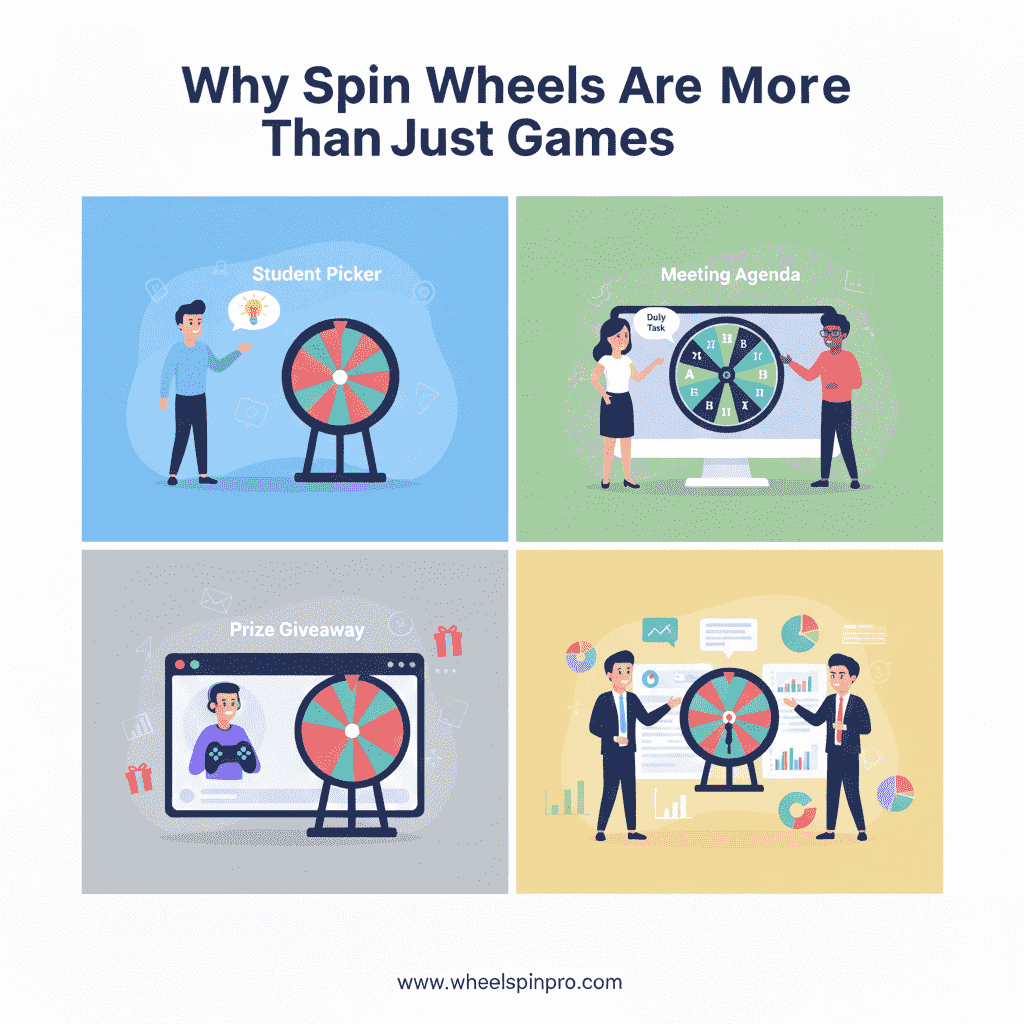
Why Spin Wheels Are More Than Just Games: The Evidence-Based Case for a Serious Tool
Dismissing a spin wheel as a toy is like dismissing a coin flip as trivial. Both statements are technically defensible and practically wrong. The coin flip is an ancient, mathematically sound mechanism for resolving symmetric decisions without bias, social friction, or deliberation cost. The spin wheel does the same thing — and considerably more. Here is the case for taking it seriously.
There is a reasonable first impression of spin wheels that goes something like this: colorful, animated, vaguely carnival-adjacent — a novelty item that belongs in classrooms and game nights, not in strategic conversations about productivity, fairness, marketing, or organizational behavior.
This impression is wrong, and the evidence against it is substantial. Spin wheels are used by teachers to address documented participation inequity. By managers to reduce the bias in task assignment that cognitive psychology has reliably identified. By marketers to activate behavioral mechanisms that produce measurably better conversion than static alternatives. By community administrators to prevent the trust damage that opaque decisions predictably cause. By event organizers to create shared engagement moments that physical and virtual environments both require.
In each of these contexts, the spin wheel is not decorating a problem with gamification aesthetics. It is solving the problem — structurally, through mechanisms grounded in behavioral research. The playful visual presentation is incidental to the function, just as the cheerful interface of a calculator is incidental to its arithmetic.
This article makes that case systematically — covering the four distinct functional categories where spin wheels solve real problems, the specific behavioral science behind why they work, and the range of contexts where their value has been documented or is directly derivable from established research.
The Four Functional Categories of Spin Wheel Value
Spin wheels are not one tool doing one thing. They are a format — a visual randomization mechanism — that serves four fundamentally different functions depending on the context in which it is deployed. Understanding the four categories is the prerequisite for deploying any one of them effectively.
| Functional Category | Core Problem Solved | Relevant Science | Primary Contexts |
|---|---|---|---|
| Cognitive Offloading | Decision fatigue and deliberation waste on symmetric choices | Ego depletion (Baumeister), Paradox of Choice (Schwartz), opportunity cost research | Personal decisions, team standups, task prioritization, daily routines |
| Fairness Infrastructure | Bias, perceived inequity, and trust damage from human selection | Procedural justice (Colquitt, Tyler & Lind), cognitive bias research (Kahneman) | Classrooms, team management, community governance, prize draws |
| Engagement Architecture | Passive participation, disengagement, and exclusion from group experiences | Experiential memory (Kolb), participation equity research (Dallimore), Zoom fatigue (Bailenson) | Remote meetings, events, workshops, social media, education |
| Behavioral Conversion | Low conversion rates from passive marketing interactions | Variable reinforcement (Skinner), dopamine anticipation (Schultz), IKEA Effect (Norton et al.) | E-commerce, lead generation, social media campaigns, brand activations |
Most commentary about spin wheels treats them as a single-use novelty. Most effective spin wheel deployments are using one of these four functional categories deliberately, with design decisions calibrated to the specific problem they are solving. The gap between those two approaches is the gap between a spin wheel that works and one that merely spins.
Spin Wheels as Cognitive Offloading Tools: Protecting Decision Quality Where It Matters
The idea that deliberation always improves decisions is one of the most persistently incorrect intuitions in human cognition. For a specific category of choices — those where all options are acceptable and the goal is resolution rather than optimization — deliberation costs cognitive resources without improving outcomes. The optimal decision strategy for these choices is fast, neutral, and final.
Roy Baumeister's ego depletion research established that willpower, self-regulation, and deliberate decision-making draw from a shared, finite cognitive resource that degrades with use. The Israeli parole board study — where judges granted parole to approximately 65% of prisoners seen early in the day and near 0% seen late, with no change in the legal merits — remains one of the most cited illustrations of this effect. Every trivial decision made through deliberation taxes the same cognitive pool that important decisions require.
Barry Schwartz's paradox of choice research added a complementary finding: more options produce worse decision outcomes, more post-decision regret, and lower satisfaction with the chosen option. The cognitive load of evaluating additional options compounds rather than improves the decision.
This is why leaders like Barack Obama and Steve Jobs famously simplified their clothing choices — eliminating a recurring trivial decision to preserve cognitive capacity for consequential ones. A spin wheel is the generalized version of that principle: systematically eliminating deliberation waste from the category of decisions that don't benefit from it.
Applied across a workday, a household, or a team's recurring decisions, the compounding effect of fast, unbiased resolution of symmetric choices is measurable in the quality of the decisions that remain. See our detailed examination of this in using spin wheels to make decisions faster.
Spin Wheels as Fairness Infrastructure: Building Trust Through Visible Process
The second functional category is more subtle but arguably more important: spin wheels as a mechanism for demonstrating fairness, not just achieving it.
Organizational psychology research on procedural justice — particularly Tyler and Lind's relational model of authority — consistently demonstrates that the perceived fairness of a decision process affects acceptance of outcomes at least as strongly as the outcomes themselves. A participant who receives an unfavorable outcome from a visibly fair process accepts it more readily than one who receives a favorable outcome from an opaque process.
This finding has profound practical implications for anyone who makes decisions that affect others. A teacher who manually selects students to answer questions is making decisions that appear biased even when they aren't — because the students cannot verify the process, and human pattern recognition defaults to suspecting bias in the absence of visible neutrality. A manager who assigns tasks through instinct is subject to the same suspicion. A community admin who selects prize draw winners privately is structurally unable to prove the fairness their participants demand.
The Bias Problem Is Structural, Not Personal
The cognitive biases that produce unfair human selection are not character defects — they are features of how the human brain processes decisions under time pressure. Availability heuristic (defaulting to options that come to mind most easily), status quo bias (preferring existing arrangements), affinity bias (favoring familiar or similar individuals), and anchoring (over-weighting the first option mentioned) all operate automatically, below conscious awareness.
Even a genuinely well-intentioned teacher, manager, or community admin is subject to these biases in selection decisions. The spin wheel does not require them to overcome their biases — it simply removes the human selection mechanism entirely for decisions where a neutral outcome is more valuable than a human-judged one.
The result: task distribution becomes fairer, participation becomes more equitable, prize draws become trusted, and the people subject to these decisions direct their energy toward the work rather than toward questioning the process. This is fairness infrastructure — and like all infrastructure, its value is most apparent when it's absent. See our full analysis in why fair decision-making matters.
Spin Wheels as Engagement Architecture: Creating Active Participation Where Passivity Is the Default
The third functional category addresses the problem that every organization with meetings, every teacher with a classroom, every event organizer, and every content creator faces: how to convert passive observers into active participants.
Passive participation is the default in almost every group context. In voluntary settings, the most confident and extroverted individuals contribute the majority of verbal output. In remote environments, the absence of social accountability makes passive attendance costless. In events, the broadcast format makes observation the path of least resistance. In marketing contexts, passive content consumption rarely translates to active engagement.
Engagement interventions that rely on individuals voluntarily breaking these norms consistently underperform — because the norms themselves have social weight that individual motivation cannot reliably overcome. Structural interventions work better: change the architecture of the situation so that active participation is the default rather than a voluntary choice.
A spin wheel is precisely this kind of structural intervention. It makes participation expected rather than voluntary, distributes it equitably rather than by confidence level, and creates shared interactive moments that passive formats cannot generate.
The unifying thread across all six contexts is the same: a spin wheel changes the default from passive to active without requiring confrontation, social awkwardness, or individual willpower to override the passive norm. For a deep examination of specific engagement mechanisms, see our guides on classrooms, remote teams, and events.
Spin Wheels as Behavioral Conversion Tools: Why Games Outperform Ads
The fourth functional category is the most commercially quantifiable: spin wheels as a behavioral conversion mechanism that outperforms passive marketing formats on measurable metrics.
The conversion advantage of spin-to-win marketing over standard popups, discount banners, and coupon codes is documented across multiple e-commerce and SaaS case studies. Lead capture rates of 5–15% versus 1–3% for standard forms. Reward redemption rates 2–3x higher than passive coupon codes. Email open rates 15–30% higher for spin-captured leads than form-captured equivalents.
These differences are not produced by better offers or larger discounts. In controlled comparisons, the same offer delivered through a spin wheel consistently outperforms the same offer delivered statically. The advantage comes from the activation of four behavioral mechanisms that static marketing cannot reach:
Neurological reward signaling peaks during uncertain anticipation — the seconds while the wheel spins — not at reward delivery. This creates genuine neurological engagement that no static offer can replicate. The spin is literally the most neurologically active moment of the entire marketing interaction.
The strongest schedule of reinforcement in behavioral psychology. Unpredictable reward magnitude produces more persistent and stronger engagement than fixed rewards. The uncertainty of which tier the wheel lands on is not a bug — it is the precise mechanism that makes the interaction more engaging than a stated fixed discount.
People assign higher value to outcomes they actively participated in creating. A discount won by spinning is perceived as more valuable than an identical discount passively received — because the spin creates earned ownership. This perception difference translates to measurably higher redemption rates and purchase intent.
Voluntary action creates forward psychological momentum. A user who chooses to submit their email and spin has made an active commitment that carries through to redemption at higher rates than passive form-fillers who made no comparable commitment. The spin initiates a behavioral sequence; commitment consistency sustains it.
These four mechanisms activate simultaneously in a spin interaction — which explains why the format outperforms alternatives that activate only one or two. For the full marketing application, see our guides on website engagement, lead generation, and marketing campaign gamification.
Why the Same Format Works Across Such Different Contexts
It is worth pausing on what might seem like a puzzling consistency: the same visual format — a spinning wheel with labeled segments — is used to solve problems as different as classroom participation inequity, marketing conversion rates, prize draw trust, and cognitive decision fatigue. Why does one format work for all of these?
The answer is that the spin wheel is not solving four different problems. It is applying three core properties in different combinations to different contexts:
Property 1: Visual Performed Randomness
The spin produces a random outcome in front of observers — not privately, not opaquely, but publicly and visibly. This visual performance of randomness is what creates trust in prize draws, acceptance of outcomes in group decisions, and the engagement of live-stream audiences. Any format that produces a random outcome privately — a random number generator, a private spreadsheet selection — lacks this property and cannot achieve the same trust effect.
Property 2: Equal Probability Without Human Agency
Every option on a well-designed spin wheel has equal probability of selection, determined by a neutral algorithm rather than a human with preferences, biases, and relationships. This removes the source of perceived unfairness from every selection decision. The wheel has no favorite, no relationship history, no subconscious bias — which is why its selections are accepted where human selections are questioned.
Property 3: Anticipation Arc with Defined Resolution
The spin creates a period of genuine uncertainty — nobody knows where it will land — that resolves into a definitive, unambiguous outcome. This is the anticipation arc that produces dopamine responses in marketing contexts, sustained attention in educational contexts, and shared excitement in event contexts. The arc is short enough to maintain attention and long enough to generate genuine investment in the outcome.
What Spin Wheels Cannot Do: The Honest Case for Their Limits
A thorough case for spin wheels requires an honest accounting of their limits — because misapplied, they produce exactly the problems they are supposed to solve.
Spin wheels are not appropriate for:
- Decisions requiring specific expertise — task assignment that requires a particular skill set, where any team member is not equally capable of the outcome
- Decisions with asymmetric risk or consequence — medical, legal, financial, or safety decisions where options have meaningfully different consequences
- Decisions requiring human accountability — where someone must own the decision, justify it, and be answerable for its outcome
- Decisions that require knowledge of individual circumstances — where a team member's capacity, health, or situation should influence the outcome
- High-stakes marketing decisions or strategy — where the quality of the choice has significant economic consequences that research and judgment can improve
The framework is simple: if deliberation or judgment genuinely improves the outcome, apply deliberation or judgment. If it doesn't — if the primary cost of continued deliberation is time, cognitive depletion, and social friction, with no benefit in outcome quality — a spin wheel is not just acceptable. It is the rational choice.
Developing the habit of distinguishing these two categories is the entire practical skill. Most people who use spin wheels effectively are not using them for everything — they have developed a reliable sense of which decisions benefit from judgment and which are best resolved by the wheel.
The Research Foundation: What the Science Actually Says
The case for spin wheels is not built on anecdote or product marketing. It is built on a convergence of research from several fields that independently reach compatible conclusions. Here is a consolidated overview:
| Research Area | Key Finding | Spin Wheel Implication | Primary Researchers |
|---|---|---|---|
| Decision fatigue | Deliberate decision-making degrades with use; later decisions are lower quality | Spin wheels for recurring symmetric decisions preserve cognitive capacity for important choices | Baumeister et al. (1998) |
| Procedural justice | Process fairness affects outcome acceptance as strongly as outcome fairness | Visible spin selection produces higher acceptance than opaque human selection of identical outcomes | Colquitt (2001), Tyler & Lind (1992) |
| Cognitive bias | Availability, anchoring, affinity, and status quo biases operate automatically in selection decisions | Spin wheels remove the human selection mechanism that introduces these biases | Kahneman & Tversky (1974) |
| Participation equity | Voluntary participation systematically advantages extroverts and socially dominant individuals | Random selection equalizes participation across personality, gender, and cultural backgrounds | Dallimore, Hertenstein & Platt (2013) |
| Dopamine anticipation | Neurological reward signaling peaks during uncertain anticipation, not at reward delivery | The spin phase creates genuine neurological engagement that static alternatives cannot replicate | Schultz (1998) |
| Variable reinforcement | Unpredictable reward schedules produce the strongest, most persistent engagement responses | Variable reward tiers in spin-to-win wheels produce higher engagement than fixed offers | Skinner (1938, applied) |
| IKEA Effect | Active participation in producing an outcome increases perceived value of the result | Rewards won by spinning are perceived as more valuable than identical rewards passively received | Norton, Mochon & Ariely (2012) |
| Paradox of choice | More options produce worse decisions, more regret, and lower satisfaction | Spin wheels resolve multi-option choices without the deliberation overhead that degrades outcomes | Schwartz (2004) |
These eight research findings do not require each other to be valid. They come from different fields, different methodologies, and different research traditions — and they independently converge on the same practical conclusion: for a specific, common category of human decisions and interactions, random visible selection is not just acceptable but optimal.
WheelSpinPro: Built for Every Functional Category
WheelSpinPro is designed to serve all four functional categories — cognitive offloading, fairness infrastructure, engagement architecture, and behavioral conversion — with specialized formats suited to each:
- Classic Wheel — the core multi-option spinner; the right format for decisions, participation draws, and prize selections across any context
- Center Spin — designed for large-screen, high-visibility display contexts: classrooms, event stages, conference rooms, interactive whiteboards
- Combo Spin — for multi-element random selection where different categories need to be spun simultaneously
- Lucky Box — grid-format prize reveal suited to multi-tier marketing campaigns, brand activations, and prize distribution events
- Coin Toss — the binary decision tool; for two-option choices where a wheel would be excessive
- Dice Roll — for numbered selections, team games, and situations requiring a numbered random output rather than a named option
Each format is browser-based, requires no installation or account to use, works on any device, and includes results history tracking — making it practical for both one-time use and systematic deployment in recurring meeting, classroom, or campaign contexts.
The Full Picture: What a Spin Wheel Actually Is
A spin wheel is a randomization tool with a visual interface designed to make the process of random selection transparent, participatory, and socially accepted. That is a precise and complete description — and it explains why the format is used across contexts as different as kindergarten classrooms and Fortune 500 marketing departments.
Every context that benefits from a spin wheel is one where a decision must be resolved from equivalent options, the process needs to be visibly neutral, and the outcome benefits from being accepted without resistance. These conditions arise thousands of times a day in every organization, community, and household.
The game show aesthetic is incidental. The behavioral science underneath it is not. The spin wheel works because anticipation, fairness, and visual transparency are powerful human psychological levers — and they have been, long before digital tools existed to deploy them efficiently.
The question for any practitioner — teacher, manager, marketer, community admin, event organizer, or individual trying to make better use of their cognitive resources — is not whether spin wheels are "serious" tools. The evidence on that question is clear. The question is which of their four functional categories applies to the problem in front of you — and whether you are designing your deployment to activate the right mechanisms for your specific context.
That is the whole practice. And it begins with a spin.
📎 Explore the Full WheelSpinPro Resource Library
- Why Fair Decision-Making Matters — the psychology of procedural fairness and bias-free selection
- How Spin Wheels Improve Team Productivity — meeting facilitation, task rotation, and workplace equity
- Spin Wheels for Classrooms and Online Learning — participation equity and educational engagement research
- Fair Giveaways and Contests — transparent prize draws and brand trust mechanics
- Gamifying Marketing Campaigns — behavioral conversion strategy across the full marketing funnel
- Spin Wheels for Events and Team Building — live and virtual event engagement
- Spin Wheels for Remote Team Engagement — distributed team participation architecture
- Spin Wheels and Online Community Transparency — governance, trust, and conflict prevention
- All WheelSpinPro Tools — explore every spinner format and use case
Frequently Asked Questions
📚 External References
- Kahneman, D. (2011). Thinking, Fast and Slow — Farrar, Straus and Giroux. Foundational synthesis of System 1 / System 2 thinking, cognitive biases, and heuristics in decision-making — the research foundation for why human selection introduces unavoidable bias in symmetric decisions. Macmillan Publishers
- Baumeister, R. F., et al. (1998). Ego Depletion: Is the Active Self a Limited Resource? — Journal of Personality and Social Psychology. Primary research establishing decision fatigue and the cognitive resource depletion that makes spin wheel cognitive offloading valuable. APA PsycNet
- Norton, M. I., Mochon, D., & Ariely, D. (2012). The IKEA Effect: When Labor Leads to Love — Journal of Consumer Psychology, 22(3). Research on earned reward perception — why actively won outcomes are valued more highly than passively received equivalents, the mechanism behind spin-to-win's conversion premium. ScienceDirect

Written by the Wheel Spin Pro Team
The developers behind Wheel Spin Pro's spin engines and 130+ unique pickers. We write practical guides on fair random selection for classrooms, giveaways, and events. More about us.